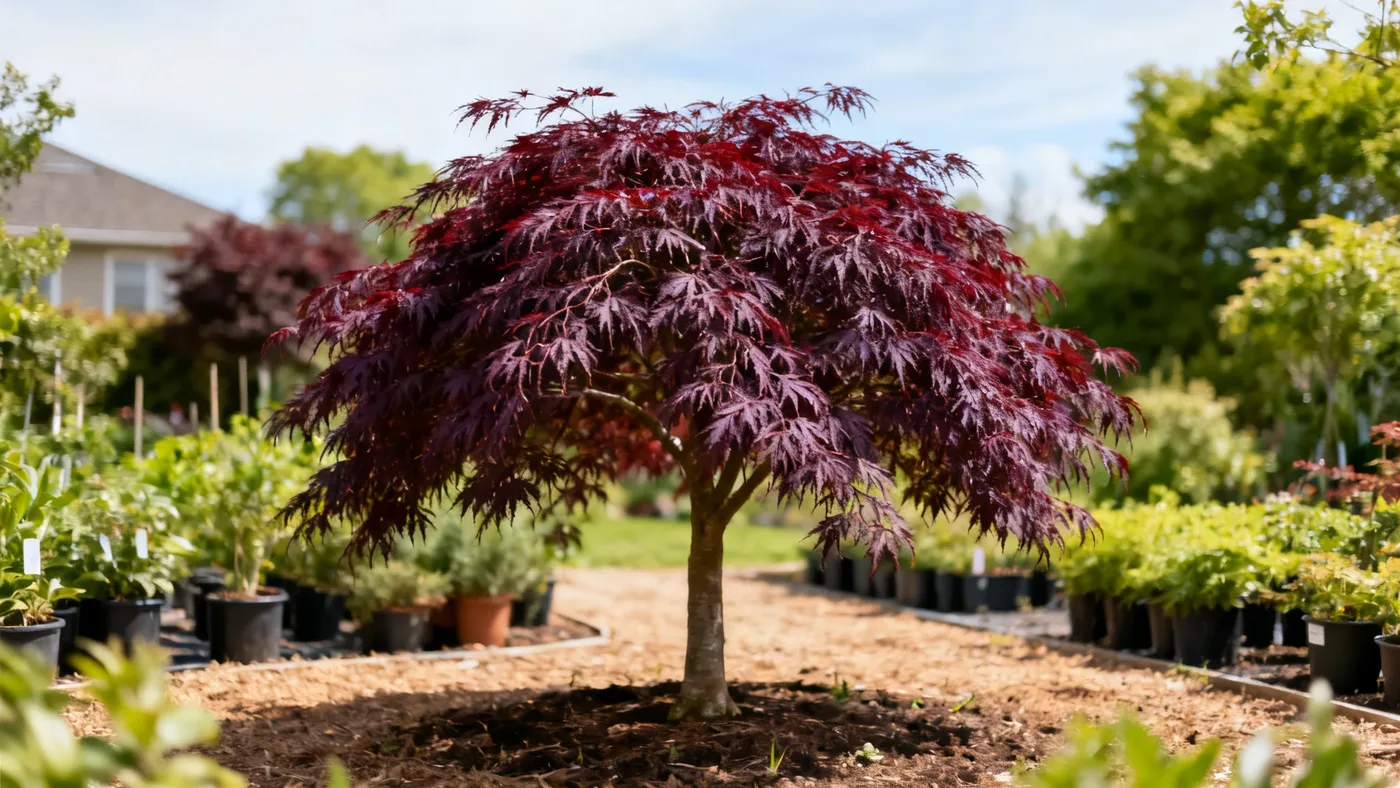
How Big Does a Tamukeyama Japanese Maple Really Get?
If you're planning to plant a Tamukeyama Japanese Maple, size matters. This cultivar is smaller than many shade trees, but larger than you might think for a "dwarf" variety. Below are the questions we hear most often from gardeners and landscapers about how big this maple actually gets.
Basic Size Questions
What is the mature height of a Tamukeyama Japanese Maple?
A Tamukeyama typically reaches 6 to 10 feet tall at maturity, though some specimens in ideal conditions can grow 8 to 12 feet after several decades. Most nursery-grown trees fall into the 6 to 8-foot range within 10 to 15 years. This assumes the tree receives appropriate light, water, and soil conditions and is grown in zones 5 through 8.
How wide does a Tamukeyama Japanese Maple get?
Expect a spread of 8 to 12 feet at full maturity, which is typically wider than the tree's height. This cascading, weeping form is one of the defining traits of the cultivar. A 15-year-old specimen might easily be 10 feet across, even if it's only 7 or 8 feet tall.
Is the Tamukeyama considered a dwarf maple?
Yes, Tamukeyama is classified as a dwarf Japanese maple (var. dissectum), but "dwarf" is relative. It's much smaller than a standard shade tree or a full-size Japanese maple, but it's not a miniature suitable for a tabletop. Think of it as a mid-sized ornamental shrub or small tree, perfect for a foundation corner or specimen planting where you have 8 to 12 feet of width to work with.
Why is a Tamukeyama wider than it is tall?
The cascading growth habit is what makes this cultivar special. The branches naturally weep and spread outward and downward rather than reaching upward, creating that fountain-like silhouette. This weeping form was selected and preserved in the cultivar when it was developed centuries ago in Japan.
Can the height and width measurements vary between trees?
Absolutely. Growing conditions, light levels, pruning, age, and regional climate all influence final size. A Tamukeyama in full sun with well-drained soil in zone 6 may grow differently than one in partial shade in zone 8. Nursery sources sometimes list different mature sizes depending on their local growing experience.
Growth Rate and Timeline
How fast does Tamukeyama Japanese Maple grow?
It's a slow grower, adding roughly 6 to 12 inches per year under average conditions. This measured pace is typical for all Japanese maples and is actually desirable if you want a focal plant that stays proportional to your garden for many years without requiring aggressive pruning.
How long does it take to reach full size?
Plan on 10 to 15 years or more for a Tamukeyama to approach its full mature size of 6 to 12 feet tall and 8 to 12 feet wide. Some growers don't consider their trees "fully mature" until they're 20 to 30 years old. This long timeline is why established specimens command higher prices at nurseries.
What size is a typical nursery-grown Tamukeyama when I buy it?
Most retail nurseries sell Tamukeyama maples in quart, #1 (1-gallon), or #3 (3-gallon) containers. A quart plant might be 12 to 18 inches tall, a #1 container plant 18 to 24 inches, and a #3 plant 24 to 36 inches or taller. The larger the initial plant, the sooner you'll see mature form.
Will my Tamukeyama keep growing indefinitely?
No, it reaches a natural plateau at 6 to 12 feet. Growth typically slows considerably after 15 to 20 years as the tree matures. At that point, you'll be managing size mainly through light pruning, not battling constant expansion.
How tall will my newly planted Tamukeyama be in 5 years?
If you plant a #1 container specimen (roughly 18 to 24 inches), expect it to be 3 to 4 feet tall by year 5, assuming moderate sunlight and consistent moisture. If you start with a quart-sized plant, it may only reach 2 to 3 feet in the same timeframe. This is a rough estimate; actual growth depends on zone, soil quality, and care.
Spacing and Placement
How far apart should I space multiple Tamukeyama maples?
Space specimens 8 to 10 feet apart from center to center if you're planting a grouping. This gives each tree room to spread without the canopies crowding each other. If you're using a Tamukeyama as a solo lawn or patio specimen, you may want even more clearance (12 feet or more) depending on what's nearby.
Can I plant a Tamukeyama in a small yard?
It depends on your definition of "small." If you have at least 12 feet of width available and reasonable setback from structures, a single Tamukeyama works well. For very tight spaces (under 600 square feet total yard), this cultivar may overwhelm the landscape at maturity.
What's the minimum space needed for one tree?
Minimum 8 feet of width, though 10 to 12 feet is more comfortable. You also want adequate clearance above for branch development and air circulation. Avoid planting directly under power lines or within 6 feet of a roof drip line, as the weeping branches can interfere.
Container Growing
Does container size affect how big my Tamukeyama gets?
Yes. A tree confined to a container will stay smaller than one planted in the ground with unlimited root space. A mature specimen in a large pot (20 to 30 gallons) might reach only 5 to 7 feet tall and 6 to 9 feet wide, rather than the full 6 to 12 feet possible in-ground.
What size pot should I use for a Tamukeyama?
Start with a pot at least as large as the nursery container. For long-term growing (3 years or more), move to a #7 or #10 container (roughly 7 to 15 gallons). Eventually, mature container specimens need 20- to 30-gallon pots or larger wooden planters to provide adequate root space and prevent root-binding.
Can I keep a Tamukeyama intentionally smaller by using a smaller pot?
You can slow growth with pot size, but this approach requires disciplined watering and pruning. Smaller pots also mean more frequent watering, especially in warm months. If size control is your goal, regular pruning of new growth and eventual root-pruning during dormant seasons is more effective than pot restriction alone.
How do I move a large container Tamukeyama?
A mature specimen in a 25-gallon pot weighs 200 to 300 pounds when moist soil is included. You'll need equipment like a hand truck or dolly to move it safely. Plan any repositioning during fall or early spring dormancy when the tree is least stressed.
Comparisons and Cultivar Choices
How does Tamukeyama compare in size to Crimson Queen Japanese Maple?
Both are dissectum cultivars and similar in mature size, reaching 6 to 10 feet tall and 8 to 12 feet wide. Crimson Queen foliage tends to stay deeper red through summer, while Tamukeyama holds color well too. Size and growing speed are nearly identical between the two.
Is Tamukeyama the smallest Japanese maple cultivar available?
No, there are smaller cultivars like 'Waterfall' and various bonsai-suitable selections, but Tamukeyama is one of the older and most compact dissectum cultivars. Other dissectums like 'Inaba Shidare' and 'Red Dragon' are similar in size to Tamukeyama.
How does Tamukeyama compare to other dwarf ornamental shrubs?
At 6 to 10 feet tall and 8 to 12 feet wide at maturity, Tamukeyama is substantially larger than a typical dwarf conifer or boxwood hedge. It's actually closer in scale to a small ornamental tree than to many "dwarf" landscape shrubs sold in nurseries.
Regional and Zone Considerations
Does climate affect how big a Tamukeyama gets?
Yes, growing conditions influence size. In cooler zones (5 to 6), growth may be slower and final size slightly smaller. In warmer zones (7 to 8), with afternoon shade in summer, the tree grows more vigorously. Zone 9 is outside the typical range for Tamukeyama and not recommended for reliable performance.
Will my Tamukeyama reach full size in zone 5 versus zone 8?
A zone 5 specimen will eventually reach mature size but may take longer, especially in the first few years after planting. Zone 8 gardens with afternoon shade offer ideal conditions for faster, fuller development. In both zones, the tree should reach its typical 6 to 10-foot height given time and proper care.
Can I grow a Tamukeyama in zone 9?
The standard hardiness range is zones 5 to 8, though some nurseries list 5 to 9. Zone 9 performance depends heavily on siting with afternoon shade to prevent summer leaf scorch. If you're in zone 9, consult your local extension service before planting.
Maintenance and Pruning Impact
Does pruning affect the size of my Tamukeyama?
Light pruning doesn't prevent the tree from reaching mature size; it simply shapes the canopy and removes dead or crossing branches. Heavy pruning stresses the tree and is not recommended. Most Tamukeyama maples need minimal pruning if sited correctly, as their weeping form develops naturally.
When should I prune to manage size?
Prune in late fall through dormancy (November through February) if shaping is needed. Avoid heavy pruning in spring or summer when the tree is actively growing. Remove dead wood and downward-growing branches only; don't cut back healthy branch tips unless the tree is crowding a structure.
Quick Reference: Tamukeyama Size at a Glance
| Characteristic | Typical Range | Notes |
|---|---|---|
| Mature Height | 6-10 ft (can reach 8-12 ft) | Reaches full size in 10-15+ years |
| Mature Width | 8-12 ft | Usually wider than tall due to weeping form |
| Annual Growth Rate | 6-12 inches/year | Slow growth is normal |
| Spacing (multiple plants) | 8-10 ft center to center | More clearance if used as specimen |
| Container Size | #1 to #3 at purchase; #7-#10 mature | Larger pots allow fuller growth |
| Hardiness Zones | 5-8 | Zone 9 possible with afternoon shade; check local extension |
| Time to Landscape-Ready Size | 5-7 years | Starting from #1 container; varies by climate |
For more details on caring for your Tamukeyama once it's established in the landscape, see our complete growing guide.