Tamukeyama Japanese Maple Roots: Spread and Distance From a House
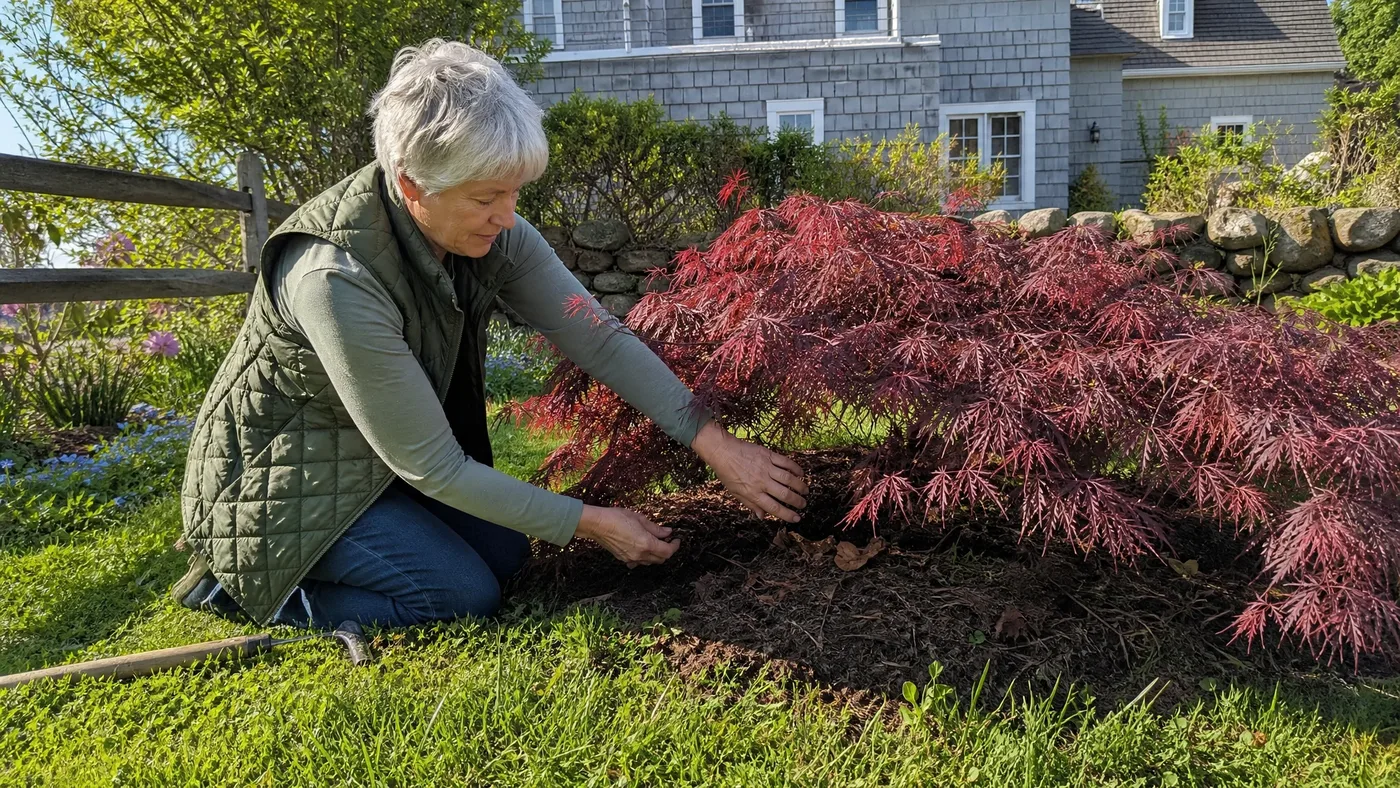
Kneel beside your Tamukeyama on a cool morning in early spring, push a hand under the mounded branches, and brush the mulch aside. You will not dig far. Just beneath the surface you meet a soft web of fine, pale threads that holds the soil together like felt, with nothing thick or woody below it.
That feel tells you most of what you need to know about where to plant it. A shallow, fibrous root layer behaves very differently from the heavy roots of a tall shade tree, so a laceleaf needs far less distance from your house, walks and pipes.
We'll walk you through the garden floor around the mound, the safe distance from a foundation, patios and buried lines, and the root plate under the canopy, then take a close look at a single feeder root. Plant it well and you get a tidy, arching mound. Plant it badly and you get a cramped plant with torn roots.
The Garden Floor Where Roots Wander
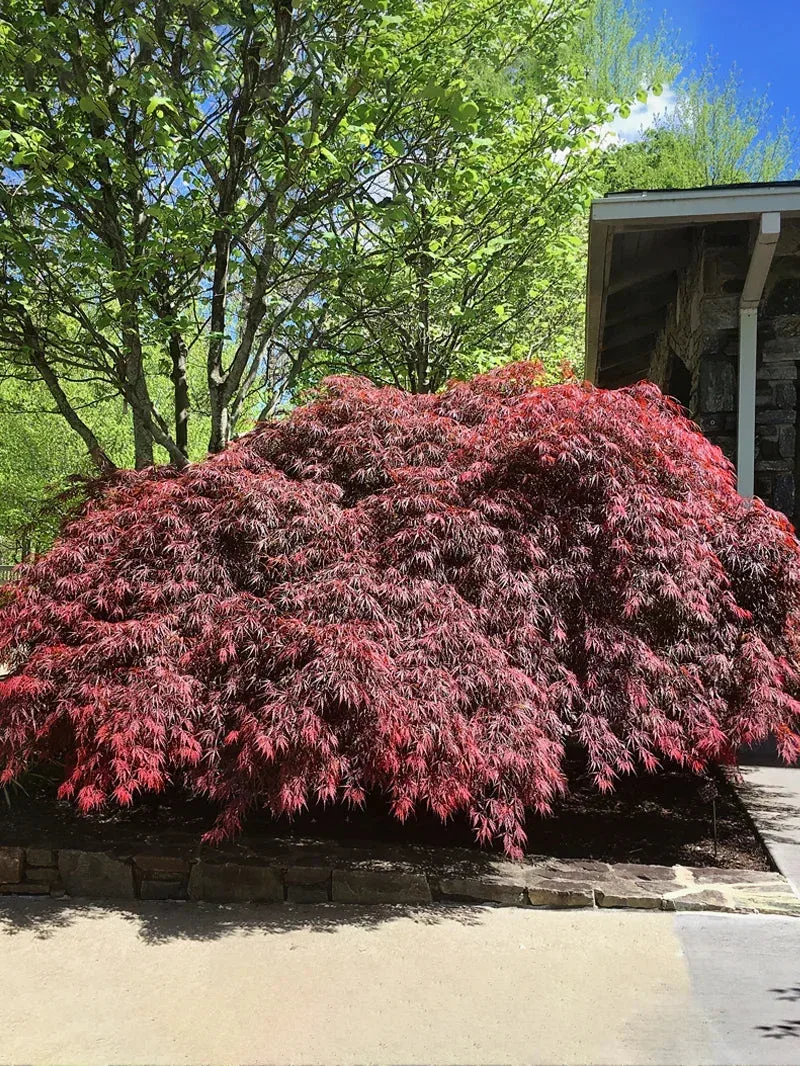
Start by picturing your whole yard from an upstairs window: lawn, beds, a walk, a neighbor's fence, and somewhere in that scene a Tamukeyama mounded to about 6 to 8 feet tall and 8 to 10 feet wide. Under that mound the roots do not plunge straight down. They fan out sideways in a shallow, fibrous layer, much as feeding roots on many maples are shallow.
That layer shares the top few inches of soil with everything else you grow. A laceleaf grows slowly, so the sharing happens gradually and you have years to adjust. Even so, decide who gets which patch of ground on day one. It is far easier than moving established plants later.
Lawn, Beds, and Close Neighbors
Grass is the first thing to give way. Shallow maple roots compete for the surface moisture a lawn needs, so do not expect turf to thrive under the mound. Replace the grass with mulch. Add shade-loving ground covers and small bulbs only near the outer edge of the branches, where your trowel does the least harm.
Mark the Footprint Before You Dig
Lay a garden hose on the ground in a circle 8 to 10 feet across, centered where the trunk will stand. Treat everything inside it as the maple's room. Keep new beds, cables you cannot move and neighboring shrub roots out of that ring. If the circle clips something you value, slide the hose until it does not. For plants to grow just outside it, see our landscape ideas for Tamukeyama.
How Near a Foundation Tamukeyama Japanese Maple Can Sit
Here is our working rule: set the trunk 5 to 6 feet from the foundation, measured from the wall and not from the edge of the planting bed. The number comes from the mound itself. Half of a mature width of 8 to 10 feet is 4 to 5 feet. Laceleaf maples are often listed at 6 to 8 feet tall by 10 to 12 feet wide, so the extra foot is room to keep growing.
One of the most common questions we get is how close to the house a maple can go. For a laceleaf, closer than most people fear. The roots stay shallow and fibrous, and UF/IFAS rates the roots of the dissectum Japanese maple as "not a problem". What it does need is space for the branches to arch and for air to move.
Compare that with an upright red leaf Japanese maple, which grows to 20 to 25 feet. Advice to keep any maple a full tree-height from the house was written for tall trees, and it overshoots for a mound this size. Our guide to mature size shows how slowly it gets there.
Measure and Mark the Spot
You need a tape measure and two stakes. Work through these steps before you dig anything.
- Find the outer edge of the foundation wall and stretch the tape straight out from it.
- Mark 5 to 6 feet out with a stake. That stake is the center of the trunk.
- Look up at the roofline. Keep the mound out from under a dripping eave or a downspout outlet, because water must never stand around the roots.
- Note which way the wall faces and choose the shadier side if you have a choice.
- Walk the wall and confirm the full circle clears windows, vents and meter boxes.
Pick the Shadier Wall
NC State advises full sun to partial shade with some afternoon shade, and extension guidance elsewhere puts it as morning sun and afternoon shade. A west wall radiates heat into fine laceleaf foliage all afternoon. An east or north wall gives the gentle light this maple likes, so use it first.
Patios, Pipes, and Paving Within Reach
Paving and pipes deserve their own measurements because they sit in the same shallow soil the roots use. The reassuring part is that fibrous feeder roots are thin and soft rather than heavy and woody. The practical part is that the mound sweeps down close to the ground, so you notice its edge long before you notice any root.
Clemson's guidance for Japanese maples beside patios or walkways is to plant taller selections that can be limbed up. Tamukeyama is not one of them. Its branches cascade to the soil, and limbing them up would spoil the shape. Give it a setback instead and let it keep its mound.
Patios and Walkways
Set the trunk 4 to 5 feet back from a patio edge or walk, which is half the mature width, so the mound clears the surface. Dig the hole by hand where it meets existing paving, and avoid cutting into the base under the slab. If space is tight, accept a little branch overhang rather than moving the trunk closer.
Buried Pipes and Lines
Call your local utility locating service before any hole is dug, and plant off to one side of anything marked. A shallow mound should never sit over a line you may need to dig up, because repairs tear roots. Fix any leaking pipe first. The table below shows what keeps each feature safe.
| Feature | What keeps it safe |
|---|---|
| Patio edge | Trunk 4 to 5 feet back so the mound clears the surface |
| Walkway | Same setback, with the hole dug by hand beside the paving |
| Water or gas line | Have it located and marked, then plant to one side |
| Septic or drain field | Ask your installer or local extension service before planting |
| Downspout outlet | Extend the outlet so water never pools in the root zone |
A Tamukeyama Japanese Maple Root Plate Beneath the Canopy
Picture a wide, shallow plate lying just under the mulch. For a Tamukeyama that plate is roughly as wide as the mound overhead and a bit wider. In our rows, the fine roots mat right below the mulch and run out past the branch tips. A tall upright maple sends roots out over a far larger area, which is why this mound is a different case.
The canopy matters too. Dense, cascading laceleaf branches shed rain outward like an umbrella, so soil near the trunk can stay drier than soil at the edge of the mound. Active roots are out at that edge. Water there, slowly, and see our guide to watering without overdoing it.
Rules for Working Inside the Plate
Treat the whole circle under the branches as a no-dig zone. These habits protect the roots you cannot see.
- Do not trench, dig or install edging inside the circle once the maple is established.
- Keep 3 to 4 inches of mulch under the canopy, as Clemson recommends, and pull it back from the trunk itself.
- Never park, drive or stack materials over the plate, because compaction squeezes out the air the roots need.
- Add new plants at the margin, by hand, and water them in gently.
One Hair-Fine Feeder Root Up Close
Lift a pinch of soil from under the mulch and tease it apart over your palm. The feeder roots of a laceleaf are pale, wiry and thinner than a strand of hair, and they branch again and again into a fine mesh that clings to soil crumbs. Rub one between finger and thumb and it feels like thread, with a slight spring and no woodiness at all.
That delicacy is why a maple this size can sit near a wall, and it is also the weak point. A thread this thin has no thick bark to protect it, and it dries out quickly in sun and wind. One pass of a spade can sever many of them, and a slow-growing plant takes its time replacing them.
How These Roots Get Hurt
Most damage is quiet and comes from ordinary garden jobs. Watch for these.
- Digging near the mound slices through the mat, so dig by hand and only where you must.
- Foot traffic and wheelbarrows compact the soil and push out air.
- Bare soil bakes and dries, so keep the mulch layer in place.
- Standing water drowns the roots, so be sure drainage is maintained and never allow water to stand around them.
Soil That Protects Them
UNH extension describes the best soil as well-drained, acidic and high in organic matter, which suits the fine, shallow mesh. Mix compost into the top layer at planting rather than deep in the hole. Our guide to the best soil for Tamukeyama covers heavy clay and fast-draining sand.
Shallow Roots Make Tamukeyama Japanese Maple a Tame Neighbor
Put the pieces together and the picture is a friendly one. A slow-growing mound, a shallow fibrous root layer and a modest footprint add up to a plant that is nicely suited to residential landscapes. It will not heave a path or crowd a wall the way a large tree can. That is why we call it a low-risk planting near buildings.
Low risk is not no risk, so keep the habits we have covered. Locate it for its ultimate size, since UF/IFAS notes the tree looks best when it is not pruned to control size. Keep it out from under downspouts, and keep trenches and shovels away from the mound.
Planting well is the last piece. Handle the root ball gently, set it at the right depth, and water it in slowly. Our guide on how to plant a Tamukeyama Japanese maple walks through each step so those fine roots settle in without a setback.
Plant Your Tamukeyama Japanese Maple a Stride From the Wall
Measure 5 to 6 feet from the wall for the trunk, 4 to 5 feet from a patio or walk, and off to one side of anything buried. Keep the circle under the branches free of digging and traffic, and keep 3 to 4 inches of mulch over the shallow roots. Those few habits are the whole root story.
Now go outside, kneel in the cool soil and set the stakes yourself. Give the mound a comfortable stride or two from the wall, tuck the mulch in around it, and then simply enjoy it as it settles and arches over its patch of ground.
Tamukeyama Japanese Maple
Nursery-grown Tamukeyama Japanese Maple in sizes from 5 Pot 2-3 ft, shipped to your door.
From $182.10
Shop Now →Afternoon shade and moist, well-drained soil are what our Tamukeyama get on our farms, and our own growers raise and pack each top-quality tree themselves. Once you have marked the right spot a comfortable stride from your wall, choose a plant for your own garden.