Tamukeyama Japanese Maple High Graft vs Low Graft
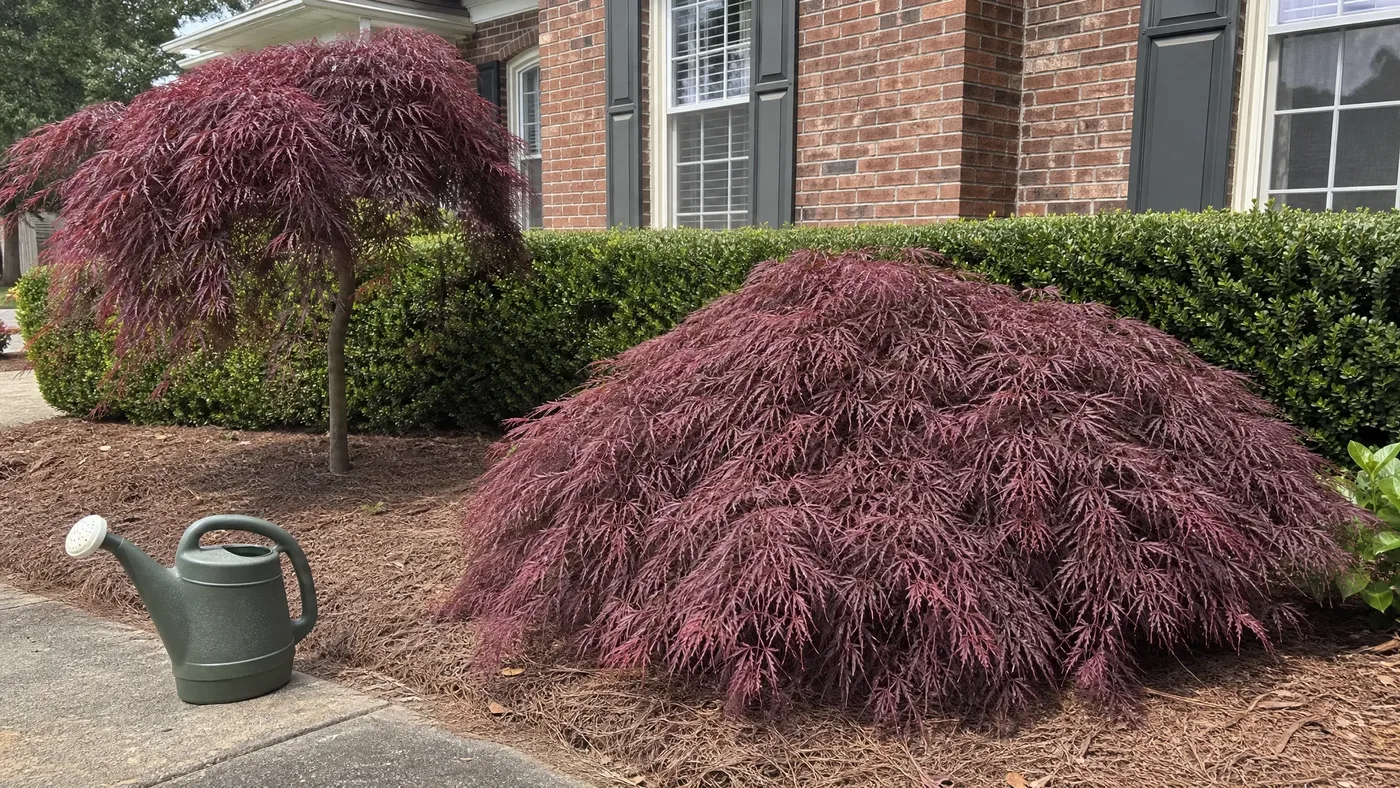
If you are staring at two trees tagged Tamukeyama, one a low mound and one a weeping top on a tall bare stick, relax. Neither is a mistake, and nobody mislabeled a pot. The surprise is that Tamukeyama has no upright trunk of its own, so the height where the top is grafted onto its rootstock decides what you end up with. A low graft gives a mound near the ground, and a high graft gives a weeper hanging from a trunk 4 to 5 feet tall.
Below, you'll find out all about how graft height shapes Tamukeyama, including how each form looks as it grows, how to stake a high graft, which site suits which shape, how to tell the weeper from upright red maples, and what a healthy graft union looks like. Choose badly and you get a mound crowding a path or a bare trunk with little to show off. Choose well and you get a tree that fits its spot for decades.
A Low Graft Mound Beside a High Graft Cascade
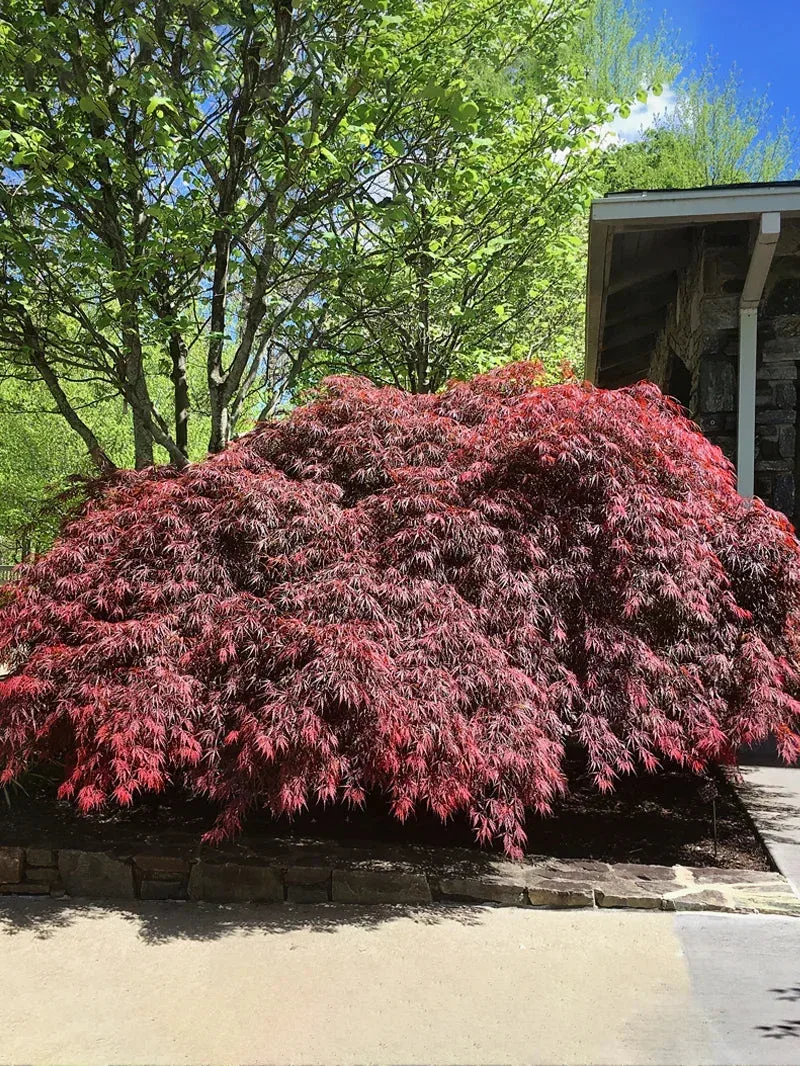
Set a low graft and a high graft side by side at the same age and you would swear they were two different maples. The low graft is a dome of fine red-purple lace that starts at the soil line, its branches arching out and down over one another. The high graft is a bare, straight trunk 4 to 5 feet tall with a crown spilling off the top like a fountain.
The reason is simple. The trunk on a high graft is rootstock, not Tamukeyama, and the Tamukeyama top is joined on where you see the crown begin. Graft height is really a decision about how much bare trunk you want to see. On a low graft that trunk is zero, which is why the dome reads like a shrub.
Both grow slowly, and neither needs shaping to look right. A high graft is often kept as a small tree with a cap-like crown, but the weeping form can be allowed to grow to the ground if a cascading appearance is wanted.
We lean toward letting it hang. Over the years the skirt lengthens and the bare trunk slowly disappears behind it. For final dimensions, see how big a Tamukeyama really gets.
This table puts the two shapes side by side.
| Feature | Low graft | High graft |
|---|---|---|
| Where the graft sits | At or just above the soil line | At the top of a 4 to 5 foot trunk |
| Bare trunk | None | A straight rootstock stem |
| Finished shape | Rounded mound branched to the ground | Standing weeper with a cascading skirt |
| Under the branches | Hidden by foliage | Open space that fills in as the skirt lengthens |
| Staking | Rarely needed | Needed for the first years |
Tamukeyama Japanese Maple Staked Wrong, and Staked Right
A high graft is a heavy, weeping crown balanced on a slim rootstock trunk, and the usual staking picture is a thin stake, a loop of wire and a shrug. Wind then rocks that crown like a sail. We often see trunks bent into a permanent lean, or a tie left on so long it has cut a groove into the bark.
What Goes Wrong
Wire, thin cord and rigid plastic ties are the usual culprits, because the trunk thickens each season and the tie does not. A stake that is too short is the other trouble. It props the trunk low while the crown still swings above it. A stake pushed in after planting can also stab the root ball.
The last error is permanence. A stake left on year after year keeps the trunk from building the strength it needs to hold the crown alone.
What Works
What we tell customers is to treat the stake as a temporary crutch and set it up so the trunk can still flex a little. Here is the sequence we follow:
- Set the stake at planting, beside the trunk and outside the root ball, before you backfill, so it never goes through roots.
- Choose a stake that reaches up toward the base of the crown, where the leverage is greatest.
- Tie with a wide, soft strap, snug but loose enough to let the trunk move, and keep the tie below the graft union.
- Check the tie every season and loosen it as the trunk thickens.
- Remove the stake once the trunk holds the crown steady in a breeze, rather than waiting for it to rot.
Our walkthrough on planting a Tamukeyama the right way covers the hole and the soil line, and the stake slots in before backfill. A low graft almost never needs one, which is a quiet advantage of the mound.
Mound on a Slope, Cascade by a Patio
Picture a sloping bank beside a driveway, where mowing is a chore and rain washes soil downhill. Now picture a patio corner where you sit with coffee and want to look at the leaves from a few feet away. Those two spots call for different Tamukeyama shapes.
Where the Low Graft Belongs
The mound shines where you view it from above or across a distance: banks, the front of a border, a corner where it can sprawl. The mounded canopy looks best when it is allowed to branch to the ground, and a low graft does that without any help from you.
Give it room. The extension range for dissectum maples runs 6 to 12 feet tall and 9 to 15 feet wide, and Tamukeyama sits toward the lower end, roughly 5 to 8 feet tall and 8 to 13 feet across. The width surprises people, so measure it against the bed. Our landscape ideas show ways to use that sprawl.
Where the High Graft Belongs
The cascade suits spots people walk past or sit beside, because the lace hangs at eye level and the trunk keeps the crown clear of mulch, lawn edging and small plants. The trouble with patios is heat and water. Paving radiates heat, and watering so that the leaves become wet in the hottest part of the day can lead to leaf scorch.
So water the soil in the morning and keep sprinklers off the crown. A crown held up on a trunk also catches more wind than a mound does. Tuck it near a wall or among shrubs, and give it some afternoon shade.
A Weeping Tamukeyama Japanese Maple Beside Upright Red Maples
Walk down a row of red Japanese maples and a high graft Tamukeyama can fool you from across the aisle. It has a straight trunk and a red crown, just as the upright ones do. Step closer and the crown drapes instead of branching outward, and the leaves are cut so deeply they look like fringe.
The upright red-leaf Japanese maples are a different scale altogether. Red Leaf Japanese Maple grows to heights of 20 to 25 feet with a semi-hemispheric form, while Tamukeyama stays around 5 to 8 feet tall and spreads wider than it rises. If you want a red maple to shade a seat or screen a window, an upright is the right tree.
Three checks help at the nursery. Look at the leaves first, which on Tamukeyama are finely cut into narrow lobes. Look at the branches next, which leave the top of the trunk and fall. Then ignore the graft bump, since many upright maples are grafted too and the bump alone proves nothing. In our rows, the weeper stands out the moment a breeze moves it.
Our look-alikes comparison goes through the other laceleaf and red maples you may see on the same bench.
A Healthy Graft Bump, Not a Worrying One
Customers usually ask us about the knob at the top of the trunk within a week of unpacking a high graft, often with a photo. Nearly every time, it is just the graft union. Kentucky's nursery extension notes that dissectum maples are propagated by a side graft onto a dissectum seedling, and a join like that leaves a visible swelling where two kinds of wood meet.
A normal union is a slight thickening, sometimes with a change in bark color or texture and a faint scar line. The wood is firm and the surface is closed over. The leaves above it are full, with the same fine lace as the rest of the crown. On a low graft the same bump sits near the soil, and we keep it just above the soil line when planting.
These signs deserve a call or a photo to us, or to your local extension office:
- Shoots rising from the trunk below the bump, with leaves plainly different from the lace above, since these come from the rootstock and not from Tamukeyama.
- A crack, gap or sunken area at the union where the bark has pulled away.
- Sap or dark staining seeping from the join, or bark peeling in sheets around it.
- A branch that wilts and dies back while its neighbors stay healthy, which can point to Verticillium wilt.
Rootstock shoots are the easy case. Cut them cleanly off at the trunk. For trouble in the leaves or branches beyond the union, see common Tamukeyama problems and fixes.
Picking Your Tamukeyama Japanese Maple Shape With Confidence
Choose the low graft if you have a bank, a border front or a spot where you want a rounded, ground-hugging shape without a stake. Choose the high graft if you want the maple at eye level beside a patio, an entry or a bench. Both grow slowly, and both end up with the same leaves and the same fall color.
If you want our straight answer, for a tree people will walk up to we would choose the high graft, and for a bank or a bed we would choose the low graft every time. We grow Tamukeyama at both heights and are glad to tell you which tree you would be getting.
Neither height is wrong, and the tags that confused you are both correct. If you are still weighing the two, send us your questions before you order and we will answer them gladly.
Tamukeyama Japanese Maple
Nursery-grown Tamukeyama Japanese Maple in sizes from 5 Pot 2-3 ft, shipped to your door.
From $182.10
Shop Now →Our growers watch each Tamukeyama through the year, from new leaves to graft unions, on our farms in moist, well-drained soil with some afternoon shade. Whichever graft height suits your spot, every tree we send is one we would happily grow at home. Browse our shop to find the right one.