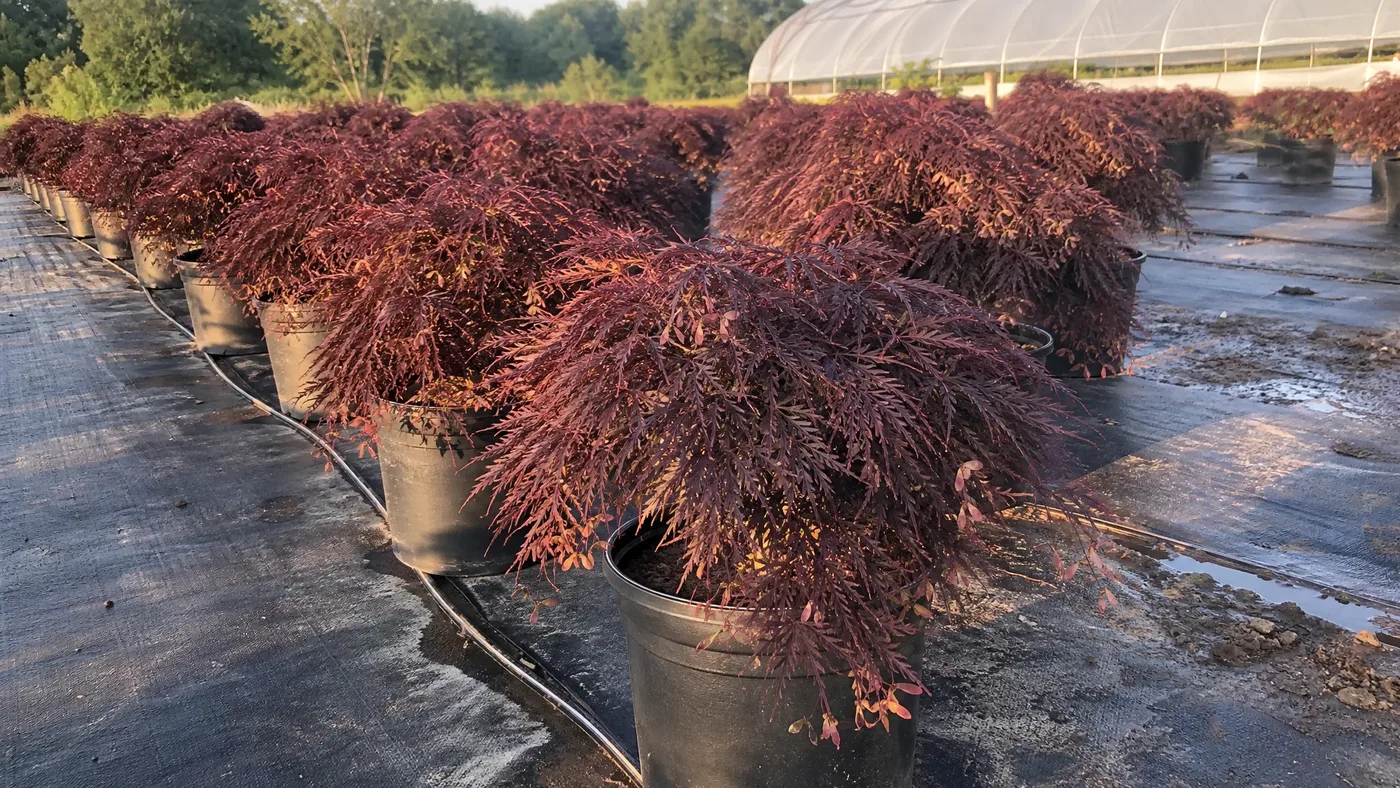
Growing Tamukeyama Japanese Maple From Seed or Cuttings
This season in our rows we noticed what we notice every year. A healthy Tamukeyama sets a good crop of winged seed after its small April flowers, and almost none of the seedlings that follow will look like the tree that dropped them. The tree you admire is one grafted clone, and seed does not copy it.
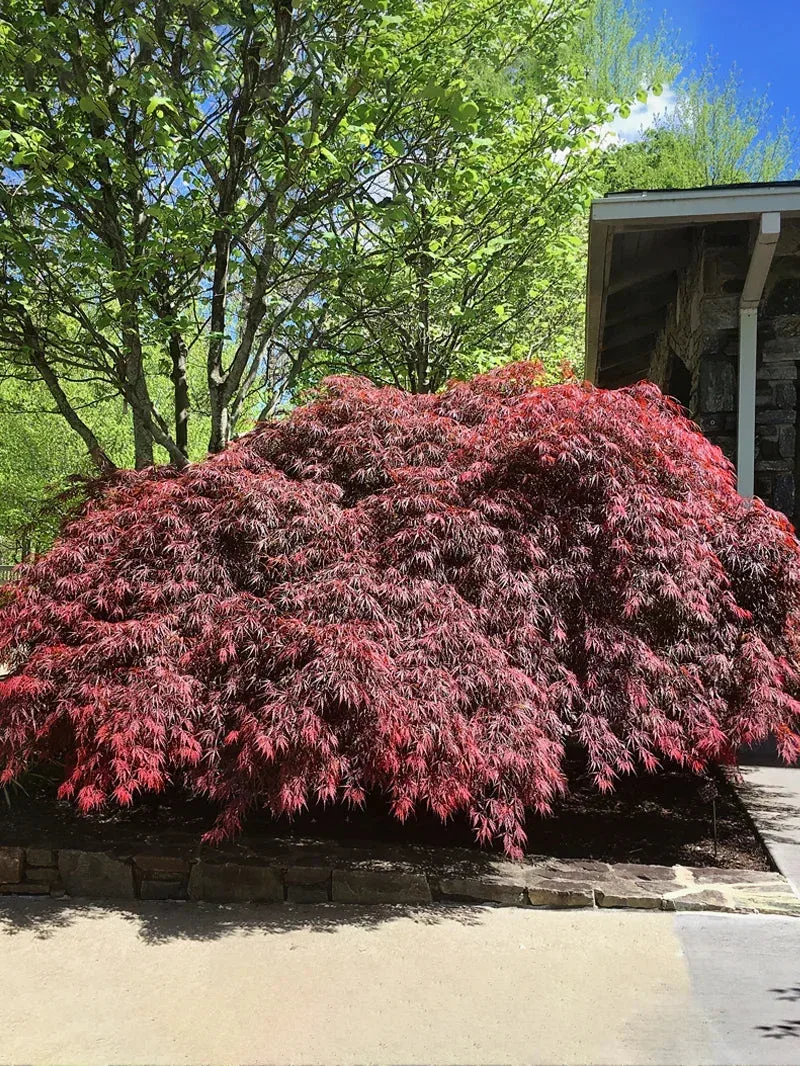
That matters because a wrong guess costs you years. A seedling takes a long time to show its leaf color and form, and by then a green or upright plant may sit where you wanted a mounded, red-purple laceleaf.
This article talks about growing Tamukeyama from seed, cuttings, grafting and air layering and answers the questions customers ask us most. Read on to learn what seedlings really look like, how poorly cuttings root, how nurseries graft the tree, and which method a home grower can try first.
Seed From a Tamukeyama Japanese Maple Grows True
The belief is that a tree which makes seed makes copies of itself. For Tamukeyama that is false. Each seed carries genes from two parents, and only one of them is your tree.
Where the Seed Comes From
Tamukeyama flowers in April as small reddish-purple umbels, and the pollinated flowers give way to two-winged samaras. Each seed holds half the genes of your tree and half from whichever maple supplied the pollen. A Japanese maple in a neighbor's yard can be that second parent.
The principle is basic plant genetics. In seed propagation, the genetic material of two parents is combined to create offspring that are different from each parent. Your Tamukeyama shuffles its genes with an unknown partner every time.
Why a Clone Cannot Breed Itself
A cultivar is a clone. Every Tamukeyama in the trade is a piece of one original plant, carried forward by grafting, so the only way to get another true Tamukeyama is to take another piece of one. Seed starts a new, genetically unique plant instead.
The belief does have a true half. The species self-seeds easily, so seedlings do turn up under your tree. They are real maples. They are not Tamukeyama.
Advice to collect seed from your favorite maple and grow it on is fine if you want rootstock or a surprise. It is wrong if you want this tree.
Seedlings Will Look Like a Smaller Tamukeyama
The belief here is that a Tamukeyama seedling is a miniature of its parent. It is not, and the spread between siblings is wide. Sow a handful and you will get a handful of different plants.
Color and Leaf
Seedlings from a Tamukeyama often come up green. Some carry red or purple tones, and the depth of that color varies from plant to plant. The finely cut laceleaf also varies, and some seedlings lose it for a broader, coarser leaf.
Do not judge a seedling by its first leaves. Color and leaf shape can shift as the plant matures, so a red seedling in its first year proves nothing.
Form and Habit
The dissectum type is mounded, with slow-growing, contorted branches. A seedling may ignore that. Many grow upright with a leader, and a few mound, so the cascading shape you want may never appear.
Tamukeyama itself stays small, roughly 5–8 feet tall with a wider spread. A seedling that shoots upward is telling you it is something else.
What to Do With Seedlings
Grow them on and judge them honestly. Compare any red, cut-leaf seedling against the cultivars in our look-alikes comparison, and read our guide to Tamukeyama identification before you give one the name. Even a close match is a seedling, not a clone.
The best use for most seedlings is as rootstock, which is how nurseries use them too.
Do Cuttings of Tamukeyama Japanese Maple Root Easily?
The belief is that any cutting from a shrub-sized maple will root if you wait long enough. For Tamukeyama the honest answer is no. Cuttings are a recognized route for a few Japanese maple cultivars, but they are the secondary route even for those.
What the Sources Say
The red-leaf cultivar Bloodgood is propagated by both grafting and stem cuttings. That tells you cuttings can work for some Japanese maples. It does not tell you they work well for a dissectum like Tamukeyama, and we found no source that gives a success rate for this cultivar.
We will not invent one. Plan on a minority of cuttings rooting, and ask your local extension service what timing and methods work in your zone.
Realistic Expectations
One of the most common questions we get is whether a snipped twig in a glass of water will root. It almost never does for this tree. Rooting, when it happens, is slow, and the cutting has to survive that wait without drying out or rotting.
A tray of failed cuttings means the tree resisted, not that you did something wrong. If you try, take more cuttings than you want plants. Treat every rooted one as a bonus.
Rooted cuttings of this slow-growing maple stay small for a long time. Expect to pot them on and shelter them through their first winters.
Rooting Hormone Fixes Poor Cuttings
The belief is that the right powder and a misting system will turn a poor rooter into a good one. The sources do not support that. We found nothing showing that hormone or mist changes how a dissectum cultivar roots.
What Hormone Does
Hormone nudges a cutting that is already able to root. It does not give an unwilling cultivar the ability. If a Tamukeyama cutting has little capacity to form roots, dipping it improves the odds a little and leaves the underlying problem in place.
Use it as a minor aid, not a fix. Spend your effort on fresh, healthy material and a clean, well-drained rooting mix.
What Misting Does
Mist keeps the leaves from drying out, which is a real need. It also keeps them wet, and wet foliage in midday heat invites scorch on Japanese maples. Too much water in the mix rots the base of the cutting before it roots.
Tamukeyama's finely cut leaves lose water fast. Keep cuttings in bright shade, out of afternoon sun, and water the mix more than the leaves. That does more than any gadget, and the same rule keeps the parent tree from scorching. Our guide on watering Tamukeyama covers the mature tree.
Nurseries Grow Tamukeyama Japanese Maple on Its Own Roots
The belief is that the tree in a pot started as a cutting. It did not. Producers graft the desirable Japanese maple varieties onto rootstocks of other maples, and most cultivars are grafted too.
How the Graft Works
The rootstock is a young maple grown for its roots. A short piece of Tamukeyama wood, the scion, is joined to it so that their growing layers meet and knit together. From then on the roots feed the Tamukeyama top, and the top is a clone of the original plant.
That is why the grafted tree is the only dependable way to get a true Tamukeyama. The rootstock is a seedling and carries its own genes, so the roots are never Tamukeyama roots.
The Union and Suckers
You can see the join as a swelling or a slight change in bark on the lower trunk. Our guide to high graft versus low graft explains how that point affects the shape you buy.
Watch the rootstock below the union. A shoot with plainer, greener leaves that appears there is rootstock, not Tamukeyama. Cut it off at its base before it outgrows the grafted top.
Grafting Is Beyond a Home Grower
The belief is that grafting is a trade skill closed to hobbyists. That is overstated. A careful beginner can try it, but expect failures in the first seasons and treat each success as a gain.
Timing matters more than technique. We do not have a trusted source for the exact grafting window in your zone, so ask your local extension service. The steps below are the order we follow.
- Pot a healthy young maple seedling to serve as rootstock, and let it establish before you touch it.
- Cut scion wood from your Tamukeyama while the buds are still dormant, choosing firm, pencil-thick shoots.
- Trim the scion and rootstock with a very sharp, clean knife so that each has one smooth, flat cut.
- Press the two together so their green inner layers touch along at least one side.
- Bind the join snugly and seal it so that it cannot dry out.
- Keep the grafted plant sheltered and moist but not soaked, and remove rootstock shoots as they appear.
Take scion wood sparingly from the parent tree, and cut it the way our pruning guide describes, so the tree keeps its shape. If a graft fails, the rootstock is still alive. Try again next season with more care at step 4.
Air Layering Is the Safe Backup
The belief is that air layering is a gentle method that always works. It is the safest home route, but not a sure one. It roots a branch while it is still feeding from the parent, which is why it works where cuttings fail.
How to Air Layer
Choose a low, pencil-thick branch on your own Tamukeyama. Remove a ring of bark about the width of the branch, scrape the exposed wood clean, and pack damp sphagnum moss around the wound. Wrap the moss in clear plastic and tie both ends tight.
Check the moss now and then and keep it damp. When roots show through the plastic, cut the branch below the ball, pot it in a well-drained mix, and shelter it in shade until it settles.
What to Expect
You get a true Tamukeyama on its own roots, which is something no nursery plant offers. Expect it to take a full season or more, and expect some layers to fail. The method gives you one or two plants, not a production run.
Growth afterward is slow. The species manages 10 to 15 feet in 15 years, and cutleaf types are usually less than eight feet tall, so a layered Tamukeyama stays modest for a long time.
This table compares the four routes for a home grower.
| Method | True Tamukeyama? | Home Difficulty |
|---|---|---|
| Seed | No | Easy to sow, wrong result |
| Cuttings | Yes, if they root | Poor odds, slow |
| Grafting | Yes | Demanding, expect early failures |
| Air layering | Yes, on its own roots | Moderate, slow, few plants |
What the Sources Settled for Tamukeyama Japanese Maple
Two beliefs held up in part. Seed is easy to get and seedlings do appear, and cuttings can root on some Japanese maples. Four did not hold up: seed does not copy the parent, seedlings are not miniatures of it, hormone and mist do not rescue a poor rooter, and nurseries do not grow this cultivar on its own roots.
Try air layering first if you own a mature tree and want a second one. Choose grafting if you enjoy fine work and accept some failures. If you have no parent tree or want a sure result, a grafted tree from a grower is simpler.
Tamukeyama Japanese Maple
Nursery-grown Tamukeyama Japanese Maple in sizes from 5 Pot 2-3 ft, shipped to your door.
From $182.10
Shop Now →Tamukeyama needs a spot of partial shade and soil that stays damp yet drains freely, and that is how our growers raise every one of ours on their own farms. We are a small team of growers producing top-quality trees and shrubs, and we know that a grafted plant is the surest way to get the true maple this guide is about. Take a look and pick out one for your own garden.