Tamukeyama Japanese Maple Name, Spelling and Identification
The tag is handwritten in marker and taped to a pot at a weekend plant sale. It reads "Tamuke Yama Japanese Maple," with a price circled underneath. The spelling looks slightly off, and you start to wonder what you are actually holding.
Tamukeyama is a Japanese name on a Japanese maple, a weeping laceleaf in the dissectum group. Names like that get mangled when people copy them by ear. A wobbly tag does not always mean a wrong tree, but it is the first thing to check.
This guide covers everything you need to know about the name and identity of this cultivar, from where the name comes from and how to say it to the typos on tags, the look-alikes that get swapped in, and the questions to ask before you pay. A correct label is what lets you find the right care advice for a tree you will live with for decades.
The Name Behind Tamukeyama Japanese Maple
Tamukeyama is a Japanese cultivar name, and cultivar names are not Latin. They are labels a grower or collector gave to one selected plant, which is then multiplied by grafting so every copy matches the original. That is why the name matters so much. It is the only thing that says which of the many laceleaf maples you bought.
Where the Name Sits in the Botanical Ladder
Read the full name from left to right and it narrows step by step. Acer is the maple genus, palmatum is the Japanese maple species, and dissectum is the group of weeping, finely cut forms. The part in single quotes, 'Tamukeyama', is the one plant that every graft is copied from.
The jump in size between those levels is large. The species as a whole reaches 10 to 25 feet, while the dissectum group stays at 6 to 12 feet tall and 9 to 15 feet wide. A tag that stops at "Japanese maple" tells you almost nothing about how much room you need.
What the Name Does and Does Not Tell You
We would rather be honest than hand you a tidy origin story. The botanical sources we rely on do not spell out what the word means or who first named the tree, so we will not repeat a translation we cannot back up. If a seller recites a detailed legend, ask where it came from.
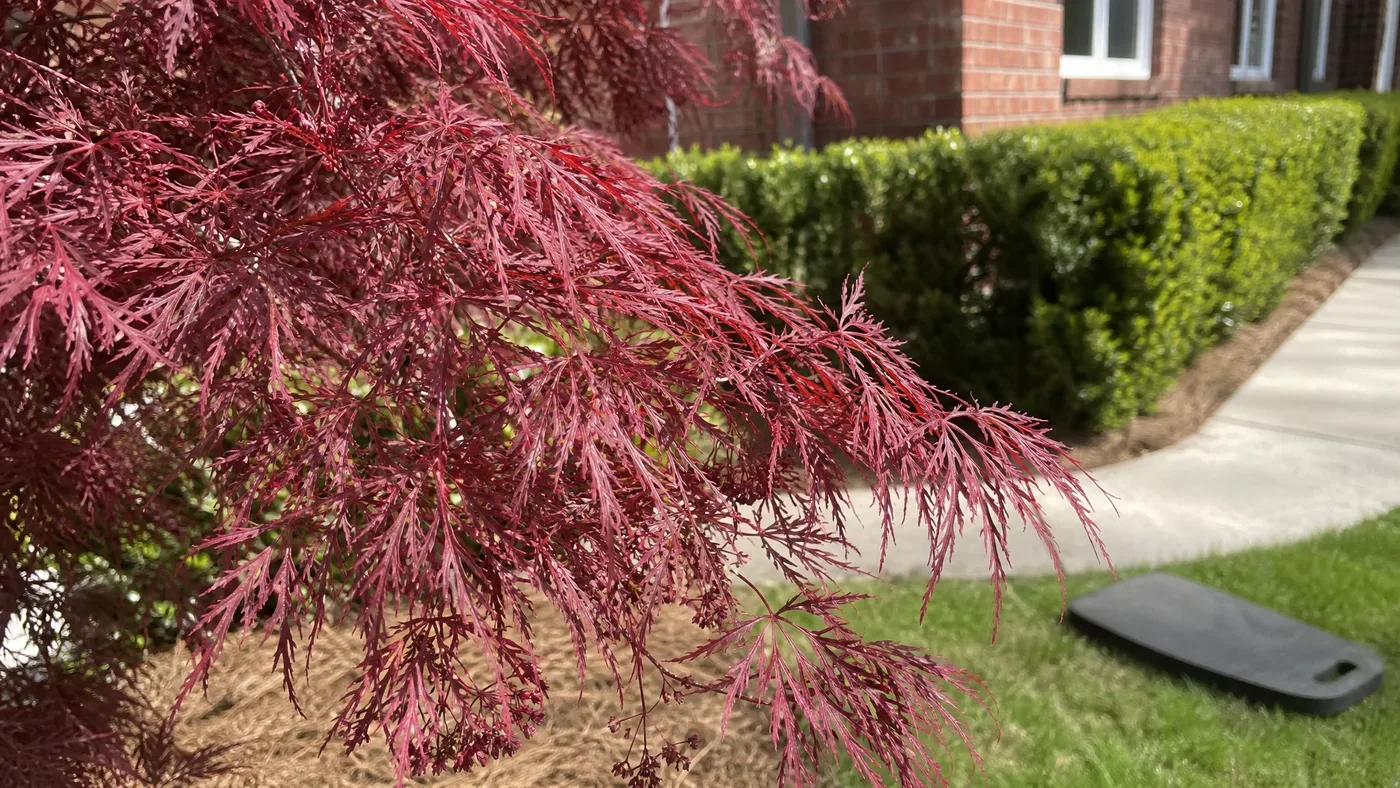
What the sources do agree on is the description. NC State Extension calls it a weeping lace-leaf with deep burgundy, dissected foliage. That is the plant behind the name: cascading branches, finely cut leaves, dark red-purple color.
How It Became a Nursery Staple
We have no documented date for when it entered the trade, and we will not guess one. What we can say is that it became one of the standard red weeping laceleafs, which is exactly why its name gets borrowed. Once a name sells well, it shows up on tags for plants that only resemble it.
Saying Tamukeyama Out Loud
Japanese syllables are even and open, so the trick is to give every one equal weight. Say it as five beats: tah-moo-keh-yah-mah. The "a" is a flat "ah" as in "father," the "u" is a soft "oo," and the "e" sounds like the one in "bet."
English speakers tend to lean hard on one syllable, usually "KEY" or "YAH," and to turn the "e" into a long "ee." Keep it flat and steady. Nobody at a nursery counter will correct you, but a clear pronunciation helps a clerk find the right row in the inventory.
A split that helps your memory is Tamu, ke, yama. It also explains the most common error on tags. People hear a space where there is none and write "Tamuke Yama," which is how the tag in our opening got its two words.
The name is one word with no hyphen, and the botanical form writes it in single quotes: Acer palmatum var. dissectum 'Tamukeyama'. If you are ordering by phone, spell it out letter by letter once, then ask the seller to read it back.
Misspellings and Synonyms on Tamukeyama Japanese Maple Tags
Search for this tree and you will see the same handful of errors again and again. Most are harmless typos for the right tree. A few signal a plant that was never labeled carefully in the first place. This table sorts the usual suspects by what they most likely point to.
| What the tag says | What it usually means |
|---|---|
| Tamuke Yama | Right tree, split into two words by ear. |
| Tamukemaya, Tamukeyma | Letters swapped or dropped. Usually the right tree, but ask to see the supplier label. |
| Tamakeyama, Tamukayama | A vowel guessed wrong. Treat it as unverified until the tree itself checks out. |
| Red Dissectum, Red Laceleaf | A generic group name. It could be Tamukeyama or any other red weeping laceleaf. |
| var. dissectum or subsp. matsumurae | Two botanical placements of the same cultivar name, covered below. |
Why the Botanical Name Varies
Even reference sites disagree. NC State files the cultivar under Acer palmatum subsp. matsumurae, yet an image credit on the same page calls it var. dissectum. Our own tags use var. dissectum.
Either botanical name is fine on a tag. What matters is that the cultivar name in quotes is spelled correctly. A tag with a perfect botanical name and no cultivar at all is a bigger warning than a creative spelling.
How to Check a Doubtful Tag
When the spelling is off, work through these steps before you decide anything. They take a few minutes and cost nothing.
- Compare the pot label, the stick tag and any printed sign. If all three agree on the same odd spelling, a supplier probably printed it that way.
- Ask whether the cultivar name is on the supplier's original tag, not only on a hand-written replacement.
- Look the plant up under the corrected spelling, then compare what you find with the tree in front of you.
- If the tag is generic ("red laceleaf"), ask the seller to name the cultivar in writing. Hesitation is an answer.
Why Red Laceleafs Get Mislabeled at Nurseries
Red weeping laceleafs look a lot alike in a pot. Same cascading habit, same cut leaves, same dark tones. Oregon State notes that cultivars vary in fineness and color of leaves, but those differences are subtle in a one-gallon container in spring.
Mix-ups happen in ordinary ways. Pots of different cultivars sit side by side, a stick label gets pulled, and a replacement is written from memory. Plants resold from one seller to another can lose the original supplier tag along the way. One of the most common questions we get is whether a tree with a good-looking tag could still be something else. It could, if the tag was written by someone who never saw the original label.
The dissectum group is also broad. Oregon State says it includes cultivars with green, purple or brown leaves, some fading to green. A plant sold as "weeping Japanese maple" can fall anywhere in that range, and only the cultivar name narrows it to the burgundy one you want.
Color Is a Poor Witness
Do not trust color alone. The University of Florida notes that red dissectum leaves may turn greenish red in hot weather, and a tree in a sunny sales yard in midsummer can look quite different from the same tree in April. Color shifts with heat, light and fertilizer, so a plant that looks wrong in August may be perfectly correct.
The reverse is also true. A nearly right color on a wrong cultivar can fool you into skipping the real checks. Our page on Tamukeyama look-alikes compared goes through the named alternatives side by side.
Checking a True Tamukeyama Japanese Maple in Person
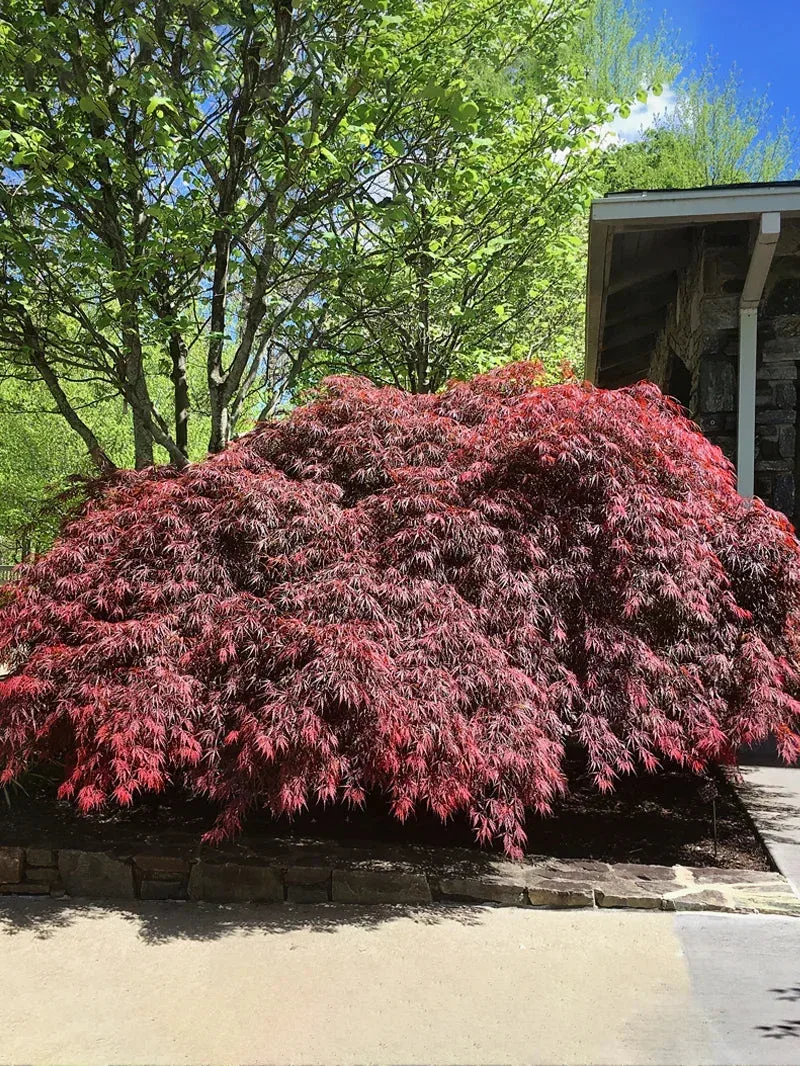
Use several clues at once, since no single one settles it. Start with the habit. A true Tamukeyama weeps and mounds, with branches that cascade outward and down. It does not stand upright like a red-leaf Japanese maple tree, which the University of Tennessee puts at 20–25 feet tall. A young laceleaf holding its branches stiffly erect is a flag.
The table below puts the main clues side by side. Treat one odd clue as a reason to look closer, and two or three as a reason to walk away.
| Clue | Fits Tamukeyama | Raises a question |
|---|---|---|
| Habit | Mounded, branches cascading down | Stiff, upright stems |
| Leaves | Deeply cut, deep burgundy | Broad lobes, bright cherry red |
| Growth | Slow, thin and weeping | Fast, coarse, lanky shoots |
| Base | Visible graft union | No sign of a union at all |
Leaf and Color Clues
Look at the leaves in good light. Tamukeyama has deeply cut, lace-like leaves in deep burgundy that can read as greenish-purple in summer and brighten in autumn. Compare several leaves, not one. If the whole plant has coarser, broader lobes or stays bright cherry red, you may be looking at another cultivar.
Ask for the plant's age as well. This is a slow grower, and a small tree with a lot of thin, weeping growth is normal. Mature size runs about 5 to 8 feet tall and 8 to 13 feet wide, so a seller promising a "tall" specimen from a young pot is describing something else.
Habit in Winter
If you are buying while the tree is bare, you actually have an advantage. Without leaves, you can see the branch structure. The University of Illinois describes the dissectum form as mounded, with slow-growing, contorted branches, and that twisting, layered framework is easy to read in winter.
The Graft Union
Find the knobby swelling near the base or on the trunk where the cultivar was joined to its rootstock. A clean union with healthy bark on both sides is a good sign. A tree with no visible union could be on its own roots or could be a seedling. Read our guide to high graft versus low graft to see what a good union looks like in each case.
Questions Worth Asking Before Paying
A seller who knows the plant answers quickly. A seller who hesitates tells you something too. These are the questions we would ask if we were standing at the counter with you.
- Where did this plant come from, and can I see the original supplier tag before the stick label?
- Is it grafted, and where is the union? A grower who sells a lot of them will point to it without searching.
- How old is the plant, and how long has it been in this pot?
- Is the name spelled the same on the pot, the stick tag and the receipt? Mismatched spellings often mean a hand-written substitute.
- Can the name be written on the receipt exactly as the tag shows it, including the quotes around the cultivar?
Customers usually ask us about size next. That is a separate question, covered in our guide to container sizes to know. A fine-looking tree on the wrong name is still the wrong tree.
Reading Online Listings
Online, you cannot touch the graft or turn a leaf over, so the wording carries more weight. Look for a full cultivar name in the title, a botanical name that matches, and photos of the actual plant rather than a single stock image.
Be careful with listings that mix several spellings in one title, or that call the tree only "red lace leaf maple." Both patterns usually mean the seller is writing for search engines first. Message them and ask for the cultivar name exactly as it appears on the supplier tag.
What Comes After the Purchase
Once the name checks out, the real work starts. Our complete care guide covers light, soil and watering. If you were choosing between this tree and another red weeper, the Crimson Queen comparison helps you decide.
A Tamukeyama Japanese Maple Name You Can Trust
A correct name protects a few things. It tells you how big the tree will get, and the University of Arkansas describes cutleaf types as usually under eight feet, so you can plan the space. It points you to the right care advice. And it lets you ask for a replacement from a seller with a clear record.
A misspelling alone is rarely a problem. A missing or inconsistent cultivar name is. Check the tag, the habit, the leaves and the graft, then take ten seconds to photograph the tag and the receipt the day the tree comes home, so the correct name stays with it long after the stick label has faded or gone missing.
Tamukeyama Japanese Maple
Nursery-grown Tamukeyama Japanese Maple in sizes from 5 Pot 2-3 ft, shipped to your door.
From $182.10
Shop Now →Our Tamukeyama spend their lives on our farms in dappled shade, in soil that stays damp but never soggy, which is how we would want one to grow in our own yards. We grow Tamukeyama under its own name, so the tree you bring home matches the name you took care to confirm. When you have settled on yours, our shop is the place to pick yours out.