Tamukeyama vs Red Dragon Japanese Maple: Which to Plant?
Walk to a woodland edge in July, where a red laceleaf sits in filtered light under taller trees, and you will see the color that gets photographed in May. Move that same tree to an open lawn and the answer changes, sometimes within a week. That July test tells you a lot about both Tamukeyama and Red Dragon, because the two look alike in a catalog and behave differently once real heat arrives.
Below, you'll find out all about how these two red laceleafs compare, including summer color, sun tolerance, mature size, leaf cut and weeping habit, and which site suits each one. Choose badly and you end up with an 8–13 foot mound where you wanted a few feet, or scorched leaf edges on a tree you hoped would hold deep red. We grow Tamukeyama, and we will tell you plainly where Red Dragon is the better pick.
Summer Color Under Full Sun
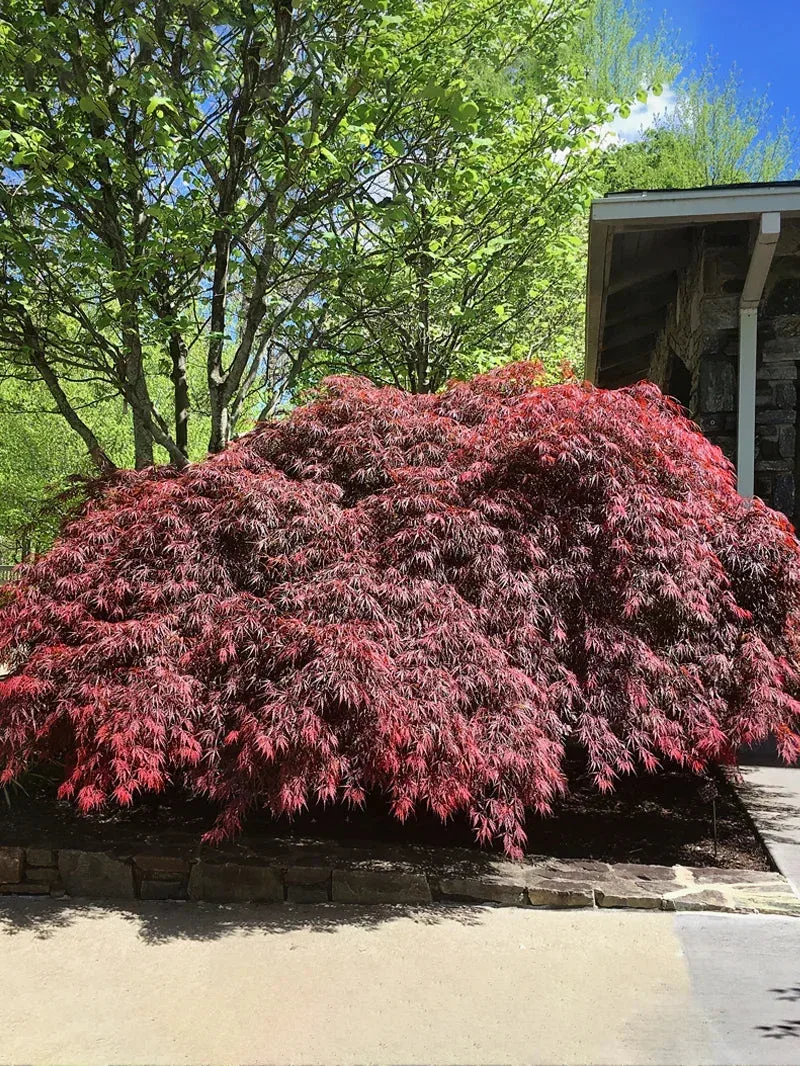
Red Dragon's reputation rests on one trait: it holds its red. The University of Missouri's pest management pages say it keeps its deep red color better than most varieties, and North Carolina State describes the spring leaves as deeply cut, fernlike and bright scarlet. That matters in July, because red laceleafs as a group lose depth of color as the weather warms.
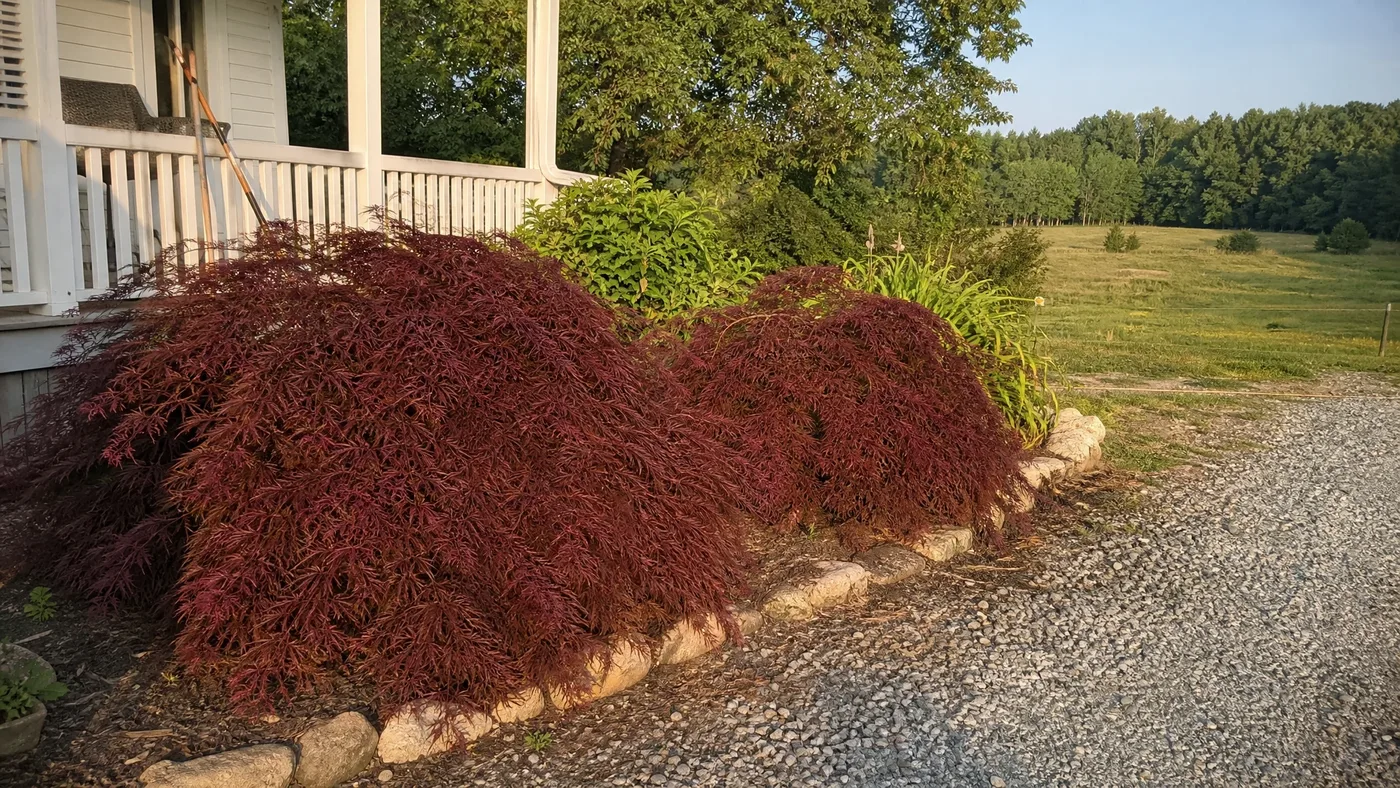
Tamukeyama opens the season in a deep crimson that leans purple. In our rows it slides toward a greenish purple through midsummer and returns to bright red in autumn. The University of Florida notes that dissectum leaves may turn greenish red in hot weather in the southern part of the range, and Tamukeyama follows that pattern. Shade slows the shift.
This is why the woodland-edge test works. A tree that gets filtered light for most of the day, with its roots in cool, mulched, leafy soil, stays darker than the same tree on an open lawn, and the gap between the two cultivars narrows. In hot, open sites both pale. The autumn return is worth knowing before you judge Tamukeyama by its August leaves, and we cover it in why Tamukeyama fall color turns fiery crimson.
One caveat on our verdict: no extension source we trust photographs the two trees side by side in July. We are leaning on the published description of Red Dragon and on what we watch in Tamukeyama every summer.
Verdict. Red Dragon holds summer red better. Tamukeyama gives some of it up in the heat and wins it back in fall.
Sun Tolerance of Tamukeyama Japanese Maple in Hot Sites
Neither tree is a true full-sun plant where summers run hot, whatever a plant tag implies. Tamukeyama is listed for full sun to part shade, yet extension advice for the dissectum group is to plant it where it gets some afternoon shade. The University of Missouri says Red Dragon needs some protection from cold wind and summer droughts, so its weak points are wind and dry soil as much as light.
Full sun works only on the right terms. The University of New Hampshire's extension says planting in full sun is only an option if the soil can be kept evenly moist through the heat of summer. Missouri State's horticulture notes add that a cutleaf maple tolerates full sun if sufficiently mulched. Both conditions apply to Tamukeyama, and we apply them to Red Dragon too.
For a hot or exposed site, these are the steps we tell customers to follow with either tree:
- Place it where it gets morning sun and shade from midday on, such as the east side of a house or beside a taller tree.
- Mulch the root zone, and pull the mulch back from the trunk itself.
- Water often enough that the soil stays evenly moist, because summer drought is the stress the care notes for both trees single out.
- Go easy on fertilizer, since excess nitrogen in the soil can lead to leaf scorch.
- Water the soil and not the leaves in the hottest part of the day, because wet foliage in midday heat can scorch too.
Cold is the other half of the question. Tamukeyama is rated for zones 5 to 8, and the wider dissectum group is listed up to zone 9. We have no verified zone figure for Red Dragon, so check with your local extension service before planting it near the cold edge of your range. Our guide to Tamukeyama sun and shade requirements goes further on exposure.
Verdict. A tie. Both want afternoon shade and steady moisture, and since Red Dragon's notes name summer drought, give it the spot closest to a hose.
Mature Size of Tamukeyama Japanese Maple and Red Dragon
Size is where the two trees part ways most clearly. Tamukeyama reaches roughly 5–8 feet tall and 8–13 feet wide, and the dissectum group as a whole runs 6–12 feet tall by 9–15 feet wide. It grows slowly as a mound that spreads wider than it rises, and it takes many years to fill that spread. Plan the footprint around the width, not the height.
Red Dragon is a different scale. It is a dwarf type that will grow only a few feet high, and it suits small gardens and containers. We have no verified spread figure for it, so check the plant tag or your local extension office, but expect a tree that sits well under Tamukeyama in both directions.
One of the most common questions we get is whether Red Dragon is just a smaller Tamukeyama. For planning purposes, close to it: Red Dragon fits the bed a Tamukeyama would swallow. You choose Red Dragon for its red and its compactness, and you choose Tamukeyama for presence.
A wide mounded canopy also changes what lives beneath it. Tamukeyama's spread casts a broad pool of shade over the soil, which suits shade-tolerant groundcovers and keeps the root zone cooler, while a dwarf shades only a small patch. Our guide on how big a Tamukeyama really gets tracks its growth over the years, and growing Tamukeyama in pots covers the container route.
Verdict. Red Dragon for small beds and pots, Tamukeyama where you have 8–13 feet to give.
Leaf Texture and Cascade Habit in Tamukeyama Japanese Maple
Both trees are laceleafs, with the leaf blade cut deeply into narrow, feathery segments. The differences are subtler than catalog photos suggest, so it helps to separate the leaf from the way the branches hang.
How the Leaves Compare
Red Dragon has lace leaves in a weeping shape, and North Carolina State lists its spring foliage as deeply cut, fernlike and bright scarlet. Tamukeyama has the same fine, feathery cut. Held side by side, we would not pretend you can tell them apart by counting lobes. At ten paces, color and scale tell you which tree you are looking at.
How the Branches Hang
Posture is the real separator. Tamukeyama builds a mound of arching branches, and the University of Illinois describes the dissectum group as mounded, with slow-growing, contorted branches. With age the outer branches lengthen and cascade until the tree reads as a dome of draped foliage. Red Dragon also weeps, but on a dwarf frame, so its cascade is a short fall and not a long sweep.
Because both are deciduous, the structure shows for months after leaf drop, and the twisted branching of a mature Tamukeyama is one of its best features. In April the dissectum group carries small reddish-purple flower clusters that give way to two-winged samaras. They are easy to miss, and we expect the same from Red Dragon.
Verdict. Even on leaf cut. Tamukeyama takes the cascade because it has more branch length to drape, and Red Dragon gives the same fine texture in a much smaller package.
Which Site Suits Which Tree?
Site decides more than cultivar in the end. Both trees need shelter from wind and a spot with afternoon shade, so the sorting comes down to space, slope and how much water you can supply. Here is how we match them to the common garden types.
Slopes and Banks
A slope drains quickly, which suits a tree that wants moist but well-drained soil, and the spread of Tamukeyama will drape over a bank or low wall in a way a dwarf cannot. The catch is that a slope also dries fast, which brings on the summer drought stress Red Dragon's notes warn about. Mulch heavily, and favor Tamukeyama if the bank is long.
Borders and Foundation Beds
In a mixed border, Tamukeyama works as an anchor, so leave room for that 8–13 foot width from the start. Both trees prefer acidic soil high in organic matter, and high pH soils cause chlorosis in dissectum maples. Check the soil before you plant, especially in beds beside foundations or walkways. Red Dragon is the easier fit under windows.
Patios and Pots
Red Dragon is the natural container tree, and Missouri names small gardens and containers as its best use. Tamukeyama's slow growth makes a large pot workable for years, but it is a stopgap and not a permanent home. On a patio, keep either one out of wind tunnels between buildings, since Red Dragon in particular needs shelter from cold wind.
Hot, Exposed Yards
If the only spot gets sun after noon, we would plant neither unless you can irrigate. Failing that, a mulched Tamukeyama in evenly moist soil is the safer bet we can document, while Red Dragon's notes flag drought directly. Consider planting a taller tree first, so it can cast afternoon shade by the time the maple fills out.
Choosing Tamukeyama Japanese Maple or Red Dragon by Site
Putting the criteria together, this table shows the tree we would plant in each situation and the reason in a line.
| Site | Our pick | Why |
|---|---|---|
| Slope or bank | Tamukeyama | Its 8–13 foot spread drapes over a bank. |
| Mixed border | Tamukeyama | A slow mounded anchor with strong winter structure. |
| Patio or container | Red Dragon | A dwarf type that suits pots. |
| Small front bed | Red Dragon | Stays a few feet high and holds deep red. |
| Hot afternoon exposure | Neither without help | Both need afternoon shade and even moisture. |
Two notes on reading it. If summer red is the whole reason you want a laceleaf, Red Dragon should win any tie. If you want a tree that grows into a feature over decades, Tamukeyama's slow, wide habit gives you that.
If you have the room, we would plant Tamukeyama, since it is the one whose behavior through a full year we know best. If the room is small, plant Red Dragon and do not squeeze a Tamukeyama into a space it will outgrow.
Where Each Red Laceleaf Earns Its Place
Red Dragon holds summer red better and stays a few feet high, so it belongs in small beds, pots and anywhere the red is the point. Tamukeyama gives up some red in July and wins it back in autumn, and it brings a wide, cascading mound that suits slopes and borders.
Both want afternoon shade, even moisture and shelter from wind, so the site matters more than the label. For other laceleafs such as Inaba Shidare, Crimson Queen and Waterfall, see our Tamukeyama varieties and look-alikes compared.
Tamukeyama Japanese Maple
Nursery-grown Tamukeyama Japanese Maple in sizes from 5 Pot 2-3 ft, shipped to your door.
From $182.10
Shop Now →Late summer is when a laceleaf shows whether its spot suits it, so that is when our growers look hardest at the leaf edges of every Tamukeyama. We raise ours on our farms in partial shade and moist but well-drained soil that runs from acid to neutral, and we only ship plants we would plant ourselves. Once you have chosen between Tamukeyama and Red Dragon, come and see the Tamukeyama we have ready.