Tamukeyama vs Orangeola Japanese Maple: Which to Plant?
"It's four in the afternoon, the sun is low across my garden wall, and I can't decide: what will each of these maples be doing to that light?" A customer put it to us almost exactly that way. It is the right question, because Tamukeyama and Orangeola look alike in a catalog photo and behave very differently once they are planted.
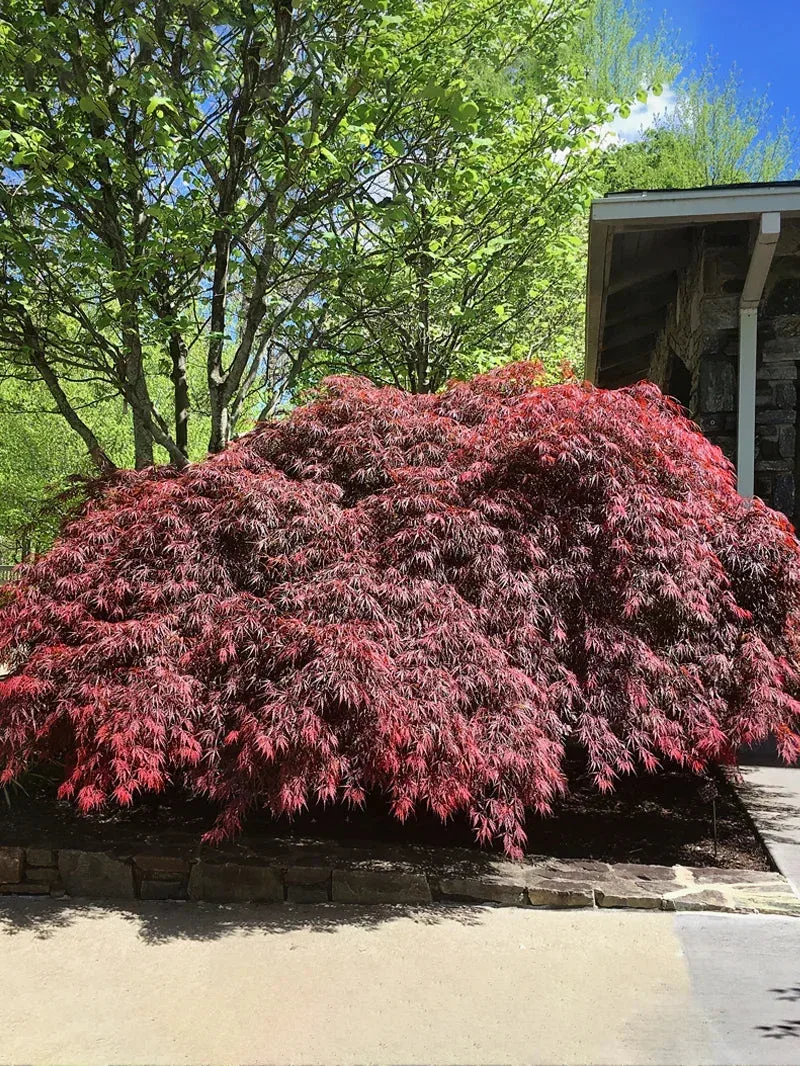
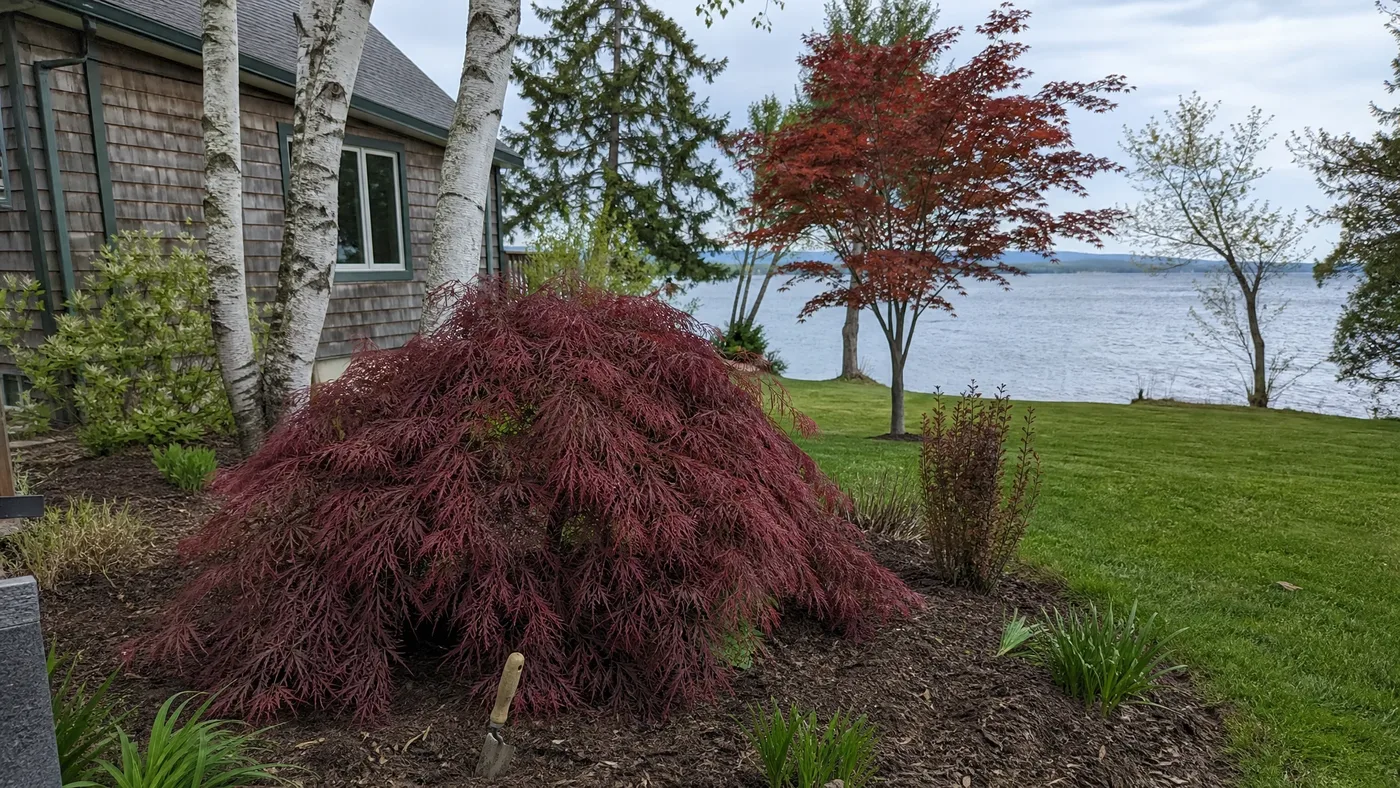
The difference comes down to timing and shape. Tamukeyama holds a deep red-purple from leaf-out through summer and turns brighter red in autumn, on a low, mounded frame. Orangeola opens orange-red, settles toward bronze-green as the heat arrives, and grows taller and more upright over the years.
In this article, we'll go through four yard situations, a narrow bed, a windy corner, a hot deck and a bright courtyard wall, and then a way of choosing by light and season.
The Narrow Side Bed Along a Fence
Picture a shallow bed with a fence behind it and a path in front. Color matters less here than how much room each tree claims as it matures, and in which direction it takes it.
Tamukeyama is a mound. Its branches arch outward and spill downward, so it ends up wider than it is tall, at roughly 5 to 8 feet high and 8 to 13 feet across. Laceleaf maples average 6–8 feet tall by 10–12 feet wide, and Tamukeyama follows that pattern. Orangeola is the taller, more upright tree of the two. Neither is a truly narrow plant, and we would rather say so now than have you discover it in year six.
When Height Is the Limit
If something sits above the bed, such as a window, an eave, or a fence top you want to keep in view, Tamukeyama is the one we would choose. It rises slowly and then spreads, so the fence stays visible behind a low cascade of lace.
Set the trunk well out from the boards, so the branches arch over the bed edge instead of pressing against the wood. A tree jammed against a fence grows lopsided toward the light, and the weeping outline that you bought it for goes missing on the fence side.
Our guide on how big a Tamukeyama really gets goes through the numbers if you need to measure carefully.
When Width Is the Limit
A long, shallow bed with open sky above it is the one place the taller habit helps. Orangeola puts more of its growth into height than into spread, so it can take less ground for its size. The trade is that it will eventually clear the fence, and the upright frame stops reading as a mound.
We don't have a firm mature figure for Orangeola that we would stand behind, so check with your local extension service before you commit to a tight spot.
Resist the Urge to Shear It Back
The usual fix for a tree that is outgrowing a narrow bed is the pruning saw, and we would steer you away from it. Laceleaf maples want minimal pruning, and when it is needed it belongs in late fall to mid-winter, while the tree is dormant. Cut in spring or summer and the wounds bleed.
Shearing also ruins the cascade. A better plan is to choose the right tree on day one, then remove only a crossing or dead branch each winter, cutting back to a joint so the lace keeps its natural drape.
Wind Across a Corner Lot With Tamukeyama Japanese Maple
A corner lot gives wind two ways in, and laceleaf maples dislike both. Extension guidance for Japanese maples is consistent on this point. Oregon State's landscape plant listing says to protect them from winds, and the finely cut leaves are the reason. Thin, deeply divided foliage dries at the edges long before a broad leaf would.
Here the mounded habit pays off. Tamukeyama keeps its leaf mass low, with branches cascading toward the ground, so the wind passes over most of the plant instead of through the middle of it. The color holds because the leaves are not being stripped of moisture hour after hour.
Orangeola carries its leaves higher and more upright, which puts them in the faster air above fence height. Its orange-red spring flush is also tender new growth, and a scorched edge shows plainly against that bright color. A burgundy leaf hides the same damage far better.
Reading Wind Damage on the Leaves
Wind injury has a signature. The tips and outer edges of the lobes turn tan or brown and curl, while the center of each leaf stays green or red. If the damage sits on the windward side of the tree only, you are looking at wind. If it runs through the whole canopy, think about dry soil instead.
Either way, a little edge crisping in midsummer does not hurt the tree. It is a cosmetic loss, and the buds set for next year are untouched.
Setting Either Tree Out of the Worst of It
Put the tree on the lee side of the house, a hedge or a solid fence, close enough to be sheltered but far enough away that air still moves around it. Mulch the root zone and keep the soil evenly moist.
On an exposed corner we would plant Tamukeyama and give it afternoon shade, as we explain in our sun and shade guide. Orangeola can work if you give it a real windbreak, but it is the less forgiving choice.
Tamukeyama Japanese Maple on a Hot Afternoon Deck
A pot on a deck is the hardest test either tree gets. The container heats through, the boards reflect light, and there is no deep soil to buffer a dry week. Our advice is to treat a deck maple as a daily-watering plant in summer.
This is where the two colors diverge most. Tamukeyama keeps a deep maroon-red through the months you sit outside, though it can drift toward greenish-purple in intense heat. Orangeola has already faded to bronze-green by the time deck season starts, so its best weeks come in spring, before the cushions come out.
Keeping the Leaves From Scorching
Both trees scorch for the same reasons. New laceleaf foliage may scorch in full sun in hot summer areas, particularly if soils are not kept consistently moist, and a small pot dries faster than any bed. We often see leaf edges crisp up on potted maples in July, and almost always the cause is a pot that dried out in the afternoon.
- Put the pot where it gets morning sun and shade from early afternoon on, even if that means moving it a few feet from where you first imagined it.
- Mulch the soil surface so the roots stay cooler and the moisture lasts longer.
- Water the soil in the morning, and keep water off the foliage, because watering so the leaves are wet in the hottest part of the day can lead to scorch.
- Skip heavy fertilizer, since excess nitrogen can also lead to scorch.
Why the Low Mound Suits a Pot
A weeping laceleaf in a container is a sculpture as much as a plant. Tamukeyama's branches fall over the rim and hide the pot, and because it grows slowly, it can stay in one container for years before it needs a larger one. A taller, more upright tree in the same pot looks perched, and it catches more wind on a high deck.
Our guide to growing Tamukeyama in pots and containers covers pot size and repotting. For a deck, we would choose Tamukeyama, because its low mound suits a container and the color lasts through the season you are actually out there.
A Courtyard Wall That Glows Orange in Spring
Now the case where Orangeola earns its place. A pale or neutral courtyard wall, cream, white or gray, shows off the plant's spring color better than any bed can. NC State lists 'Orangeola' with orange-red leaves in spring and a weeping habit, and against pale stone that flush looks lit from within.
The light matters as much as the wall. Lace leaves are thin, and low afternoon sun passes through them, so the color seems to glow. That is the four o'clock effect our customer was asking about, and Orangeola does it best in spring, before the foliage cools to bronze-green for summer.
Choosing the Wall Color First
Against a terracotta, ochre or warm brick wall, the orange-red flush blends into the background and stops reading as a feature. There Tamukeyama's burgundy gives a clearer contrast, a lacy dark silhouette that looks almost inked onto the surface.
Against pale walls, the choice is a real one, and it comes down to which season you want to see.
What You Give Up in Summer
If the courtyard is a summer room, Orangeola's bronze-green is calmer and less dramatic than Tamukeyama's red-purple. Plenty of designers like that restraint beside bold flowers, since it lets the blooms carry the scene. Tamukeyama's dark foliage, by contrast, asks for pale or silver neighbors to keep it from looking heavy.
If you want one color all season, see whether Tamukeyama stays red all summer. For more ideas on pairing it with other plants, our landscape ideas are a good start.
Reading the Light Before Choosing Tamukeyama Japanese Maple
The four cases share one lesson: the site chooses the tree more than your preference for either color does. A sheltered, bright place with a pale wall suits Orangeola. Wind, heat, a height limit, or a pot suit Tamukeyama. The table gives our call for each situation.
| Situation | Our choice | Why |
|---|---|---|
| Narrow bed, low limit | Tamukeyama | Mounded and low, so it stays below fence and window lines |
| Windy corner lot | Tamukeyama | Foliage stays low and sheltered, and burgundy hides edge damage |
| Hot deck pot | Tamukeyama | Holds maroon-red through summer and suits a container |
| Sheltered pale wall | Orangeola | Orange-red spring flush glows against light backgrounds |
Morning Sun, Afternoon Shade
Most advice says red maples need full sun for the deepest color. For Tamukeyama we say the opposite: its leaf color is best in partial shade, and full sun is tolerated rather than ideal. Aim for morning sun and some afternoon shade, which is also what most extension sources recommend for Japanese maples in general.
Counting the Months You Will Look
Think about when you will actually see the tree. A tree by the front door gets looked at every day from April to October, and Tamukeyama's steadiness gives it more good months. A tree seen mostly in spring, from a window or a gate, gives Orangeola its strongest case.
Zones differ too, and sources put laceleaf maples at roughly zones 5 to 9, so check hardiness for your own area with your local extension service.
Soil Works the Same Under Both
Soil will not break the tie, because both trees want the same thing: moist, well-drained ground rich in organic matter. High pH is the one trap. As the NC State listing notes, high pH soils cause chlorosis, a yellowing between the veins that looks worst on pale new leaves. If your soil runs alkaline, amend it and mulch well before planting either tree.
Stand Where You Will See Your Tamukeyama Japanese Maple
We would choose Tamukeyama for most yards: it stays low, copes better with wind and heat, and keeps its color through the months you are outside. We would choose Orangeola for a sheltered spot with a pale backdrop and enough height to give it, where its spring flush is the point.
Before you buy, do what a designer does. Stand where you will see the tree most often, note the light at that hour, then choose.
Tamukeyama Japanese Maple
Nursery-grown Tamukeyama Japanese Maple in sizes from 5 Pot 2-3 ft, shipped to your door.
From $182.10
Shop Now →Every Tamukeyama we ship is grown on our own farms, then potted and packed with care so it reaches you ready to plant. We're a small business that grows and sells top-quality trees, and when you're ready to plant, we'd be glad to have you take a look.