Tamukeyama vs Garnet Japanese Maple: Which to Plant?
Two red weeping laceleaf maples look identical on a nursery bench. Same cascade, same burgundy flush, same slightly smug posture. The difference shows up two summers after planting, when one has settled into a tidy mound by the window and the other has pushed over the walkway, or when one has faded toward green by August and the other still looks lit from inside.
A weeper planted without room gets cut back every year, and a weeping maple pruned like a hedge loses the layered shape that made it worth buying. This guide covers everything you need to know about choosing between Tamukeyama and Garnet, from mature size and leaf cut to summer color, sun, slope and the tiebreaker for when both fit.
Decide How Much Room You Really Have
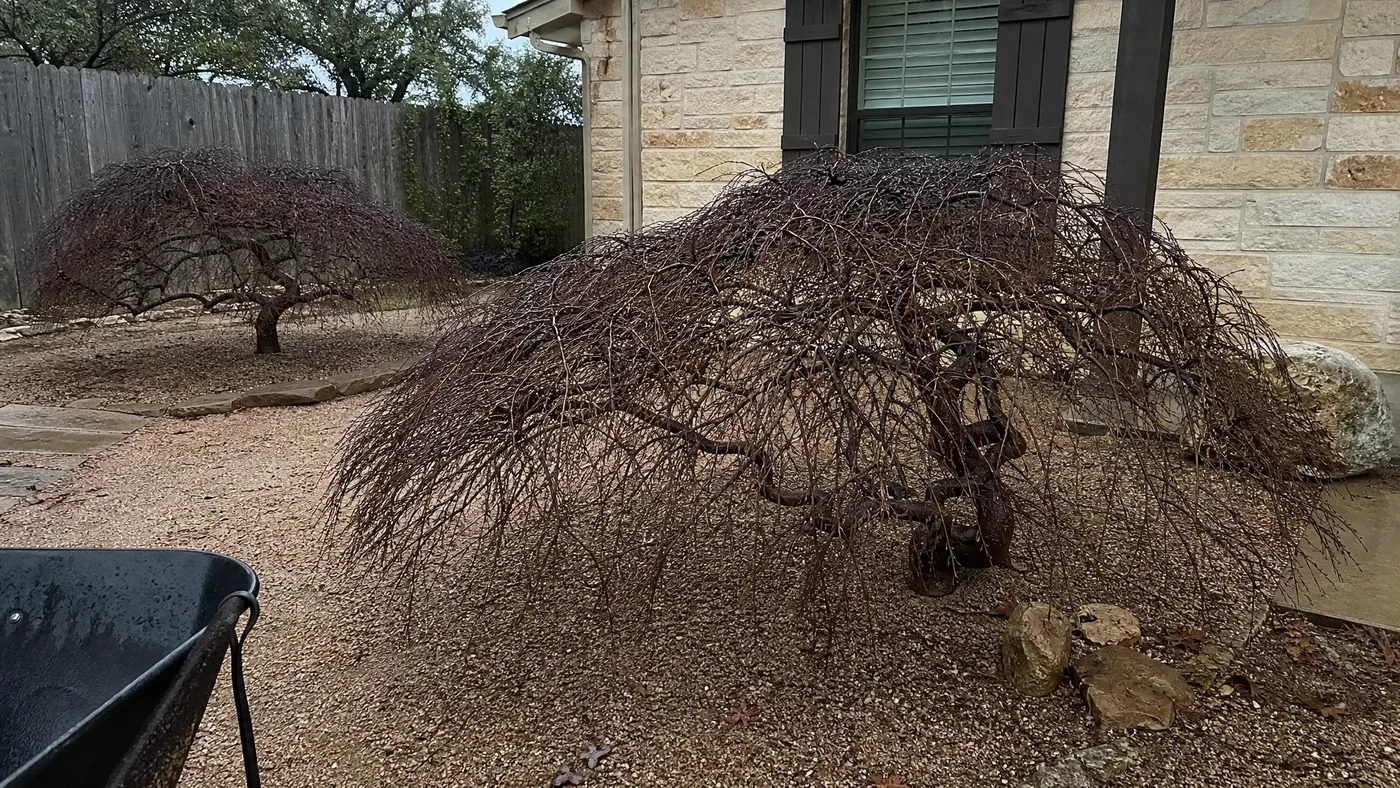
Start with space, because it is the one decision a pruning saw cannot fix later. Tamukeyama builds a mound that reaches about 5–8 feet tall and 8–13 feet across, so it sits wider than it stands. Japanese maples in general may be broader than tall, and Tamukeyama is a textbook example.
Garnet is the larger plant of the pair. Both are slow growers, so nothing looks different on planting day. The gap opens after a handful of seasons, when Garnet's branches have reached over the edge of the bed and Tamukeyama's are still draped neatly inside it. A slow tree is not a small tree, and people confuse the two constantly.
Spread is the number that catches people out. The wider laceleaf group is listed at 9 to 15 feet wide and 6 to 12 feet tall, and Tamukeyama runs at the lower end of that range. Branches arch outward and down until they touch the ground, so the footprint you see in year ten is the full circle, not a narrow trunk with a few limbs.
How to Measure Your Spot
Take a garden hose and lay it in a circle around the planting spot, with the trunk at the center and a radius of 4 to 6 feet for Tamukeyama, which is half of its mature spread. Then look at what the hose touches: a walkway, a foundation, a downspout, a neighbor's fence. Anything the hose crosses will be brushed by foliage within a decade. For Garnet, push the circle out further, and be honest about it.
Our full breakdown is in how big a Tamukeyama really gets. For this decision the rule is short. If the space is tight or the tree sits near a path, choose Tamukeyama. If you have open lawn or a deep bed and want more presence, Garnet earns its extra room.
Fine Lace on Tamukeyama Japanese Maple or Garnet?
Both trees are weeping laceleafs, so the leaves on each are cut deeply toward the base and hang in tiers. The difference is in how fine and how dense. Garnet's dissection is finer, closer to thread than blade, and the plant looks airy, with light passing through it. Tamukeyama's cut is denser and slightly coarser, which gives it more body and a heavier cascade.
That shows most from across the yard. A Garnet reads as texture, soft and a little misty. A Tamukeyama reads as a shape, a dark mound with a clear outline. At arm's length the difference is obvious, but in a phone photo it nearly vanishes, and one of the most common questions we get is whether the two can be told apart. In person, always.
Here are the traits side by side, as we see them on both trees through a full year.
| Trait | Tamukeyama | Garnet |
|---|---|---|
| Leaf cut | Denser, slightly coarser | Finer, more threadlike |
| Overall look | Solid, defined mound | Airy, see-through |
| Mature size | Smaller, wider than tall | Larger |
| Summer color | Maroon-red, can drift greenish-purple | Brighter red held longer |
| Fall color | Crimson | More orange-red |
Think about what stands behind the tree, because the backdrop changes how each leaf reads. A fine, airy Garnet can disappear against a busy background of shrubs and fence slats, while a dense Tamukeyama keeps its outline against almost anything. In winter the two converge, since bare branches on both show the same layered, cascading frame and the leaf difference is gone until spring.
Choose by taste. If you want a lacy, see-through plant that moves in a breeze, Garnet is the one. If you want a dense cascade with a defined outline that holds its own beside stone, brick or a dark fence, Tamukeyama is the better fit.
Do You Need Red Past July?
This is the decision where the two trees part ways most clearly, and it is also the one people underweight at purchase. In May, both are spectacular. The question is what you will be looking at in August.
What Tamukeyama Does in Summer
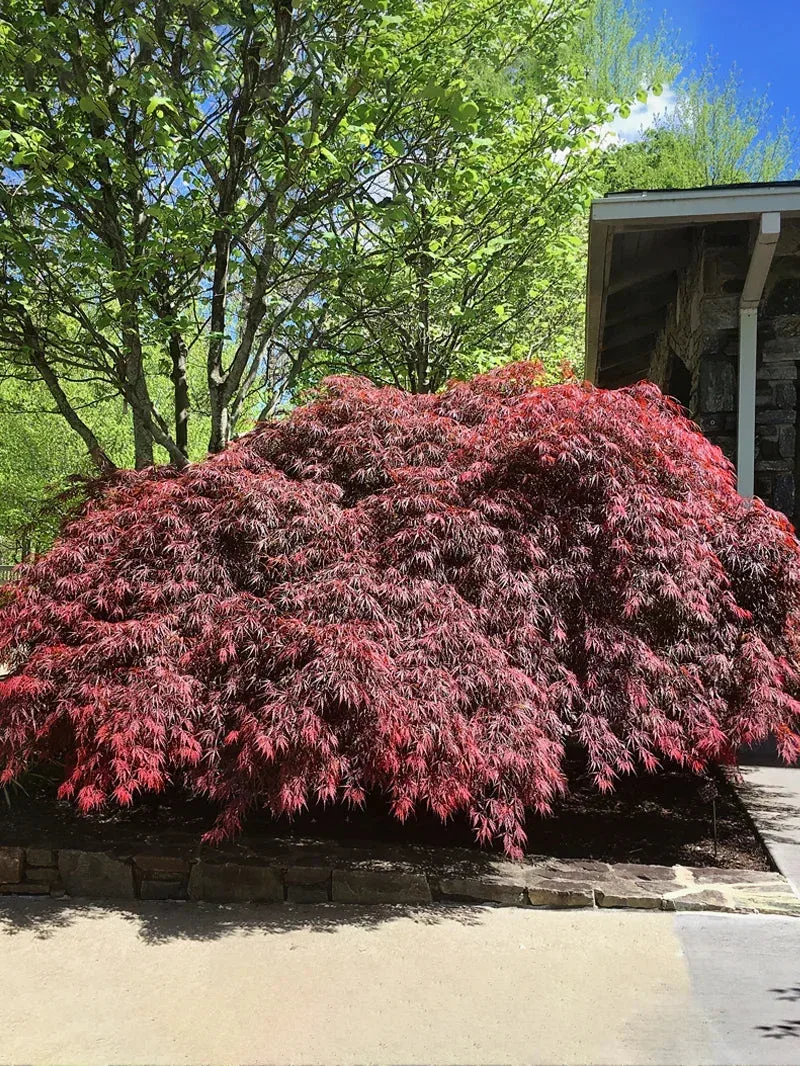
Tamukeyama opens spring in deep burgundy, then settles into maroon-red as the weather warms. In a hot summer it can drift toward greenish-purple, especially in strong afternoon sun. It is still a dark red weeper, but a quieter one by August than it was in May. We cover the details in whether Tamukeyama stays red all summer, including how shade changes the result.
The payoff for that subdued summer is fall. The leaves turn crimson, a strong finish after a restrained July.
What Garnet Does
NC State describes Garnet as a deeply cut weeping dwarf with persistent bright red spring and fall color. In practice it starts brighter and holds more of that brightness through summer than Tamukeyama does. Its fall tone leans orange-red rather than crimson.
Heat and sun still work on any red maple, so do not expect May color in the third week of August in a baking spot. Garnet simply starts from a higher baseline.
Helping Either Tree Hold Its Color
Whichever you pick, you can improve the August result with placement and habits. Give the tree morning sun and some afternoon relief, keep a layer of mulch over the root zone so the soil stays evenly moist, and water deeply instead of often. A tree that dries out and then gets flooded shows it in the leaves first. Color that fades in a hot spell often returns once the weather cools.
If you look at this tree daily from a kitchen window and want it red all summer, Garnet is the safer bet. If you can accept a deeper, moodier summer in exchange for a crimson fall, take Tamukeyama.
Matching Tamukeyama Japanese Maple to Sun and Slope
Site decides whether either tree looks good in year five. The shape of the ground matters as much as the light, and most people check only the light.
Sun and Afternoon Shade
Both trees want the same bargain: sun in the morning and relief in the afternoon. Extension advice for Japanese maples is to plant them where afternoon shade and wind protection are available. Tamukeyama's leaf color is best in partial shade, though it tolerates full sun. Our sun and shade guide goes deeper on exposures.
Leaf scorch, the crisp brown edge on laceleaf foliage, is the failure to watch for. Excess nitrogen can cause it, and so can watering so that the leaves become wet in the hottest part of the day. Water at the base, early, and go easy on feeding. Scorch shows first on the south and west side of the mound, where the afternoon sun lands.
Slope, Wind and Drainage
A slope changes the picture. Weeping maples love to spill over a bank or retaining wall, and a wider-than-tall mound like Tamukeyama does it naturally. The trouble is drainage and wind. Water runs off the top of a bank and pools at the bottom, and these maples want moist but well-drained soil, neither dust nor mud. Plant in a level pocket partway down, not on the crown of the slope.
Soil chemistry matters here too. Tamukeyama prefers acid or neutral soil, and high pH soils cause chlorosis, a yellowing between the veins. Fill from a new retaining wall is often alkaline and compacted, so test it before you plant and loosen the planting area well. Wind dries the fine foliage fast on an exposed bank, so a spot behind a wall or fence does better than the open crest.
Our pick for a tight, partly shaded slope or wall edge is Tamukeyama, because its color is best with some shade and its smaller mound will not run out of bank. A broad, open bank with room to roll downhill suits Garnet just as well.
Settling the Tie When Both Look Good
Sometimes you work through every decision and nothing breaks the tie. Both fit the space, both look good, and the light suits either. That happens more than you would think, and the answer is to stop comparing leaves and start comparing logistics. Run these four checks in order and stop at the first one that gives you an answer.
- Check hardiness. Tamukeyama is rated for zones 5 to 8, so confirm Garnet's range against your own zone with your local extension service before you commit, especially if you sit at the cold end.
- Look at the actual plant in front of you. Take the one with balanced, evenly branched weeping growth regardless of the label, because a lopsided tree stays lopsided for years.
- Compare the container sizes on offer. A larger pot is a head start on a slow plant, and our container size guide explains what each size gets you.
- Ask which one you will prune less. The smaller mound is the lower-maintenance one.
The last check deserves a closer look. A weeper that fits its space needs only light tidying, such as removing dead twigs. One that has outgrown its space needs repeated cutting back, and each round trims away the tiers that give the tree its look. A maple moved after five or six years also sulks, so the tie is best broken toward the tree you will never have to move.
In our rows, the customers who regret a purchase are almost always the ones who bought for the bench and not for year five. If all four checks still leave a dead heat, plant Tamukeyama. It is the smaller tree, and a smaller tree forgives more mistakes in placement.
Final Call on Tamukeyama Japanese Maple and Garnet
Our default is Tamukeyama, and we will say why plainly. It stays the smaller, wider-than-tall mound, it keeps its color well in the partial shade most yards can offer, and its dense cut gives you a solid shape in every season, bare branches excepted. It asks less of your space and forgives more of your site.
Garnet is the right tree for a specific person. That person has real room, wants the brightest red a laceleaf can hold into summer, likes a finer and airier leaf, and is happy with an orange-red fall instead of crimson. If that is you, do not let us talk you out of it. Garnet planted where it has space is a better tree than Tamukeyama squeezed into a corner.
A few typical yards make it concrete. On a small front yard with a walk and a window, Tamukeyama keeps the entry clear. In a courtyard with morning sun and a shaded afternoon, either tree is happy, so pick by leaf cut. On a hot, bright west-facing lot, neither tree is a good idea without some afternoon shade, and Tamukeyama is the easier of the two to tuck into it.
If you are also weighing a third red weeper, our Tamukeyama vs Red Dragon comparison works the same way as this one.
Choosing Tamukeyama Japanese Maple With Confidence
The decisions run in a fixed order: room first, then leaf cut, then summer color, then sun and slope. Tamukeyama wins on size and on shade tolerance. Garnet wins on finer lace and on red that lasts longer into summer. Pick the tree that suits your space, then the one that suits your taste.
- Foundation bed or entry beside a walk: Tamukeyama.
- Large open bed or lawn island with room to spare: Garnet.
- Part-shaded corner with afternoon relief: Tamukeyama.
- Bright bed where red must still read in August: Garnet.
- Retaining wall or bank where branches spill over: Tamukeyama.
Tamukeyama Japanese Maple
Nursery-grown Tamukeyama Japanese Maple in sizes from 5 Pot 2-3 ft, shipped to your door.
From $182.10
Shop Now →Tamukeyama does its best with dappled shade and soil that holds moisture while draining freely, so that is the spot we give every one on our farms. Our growers raise and sell top-quality trees, shrubs and grasses, tending each plant themselves. If your corner, bed or wall edge has pointed you toward Tamukeyama over Garnet, let one of ours be the first you plant.