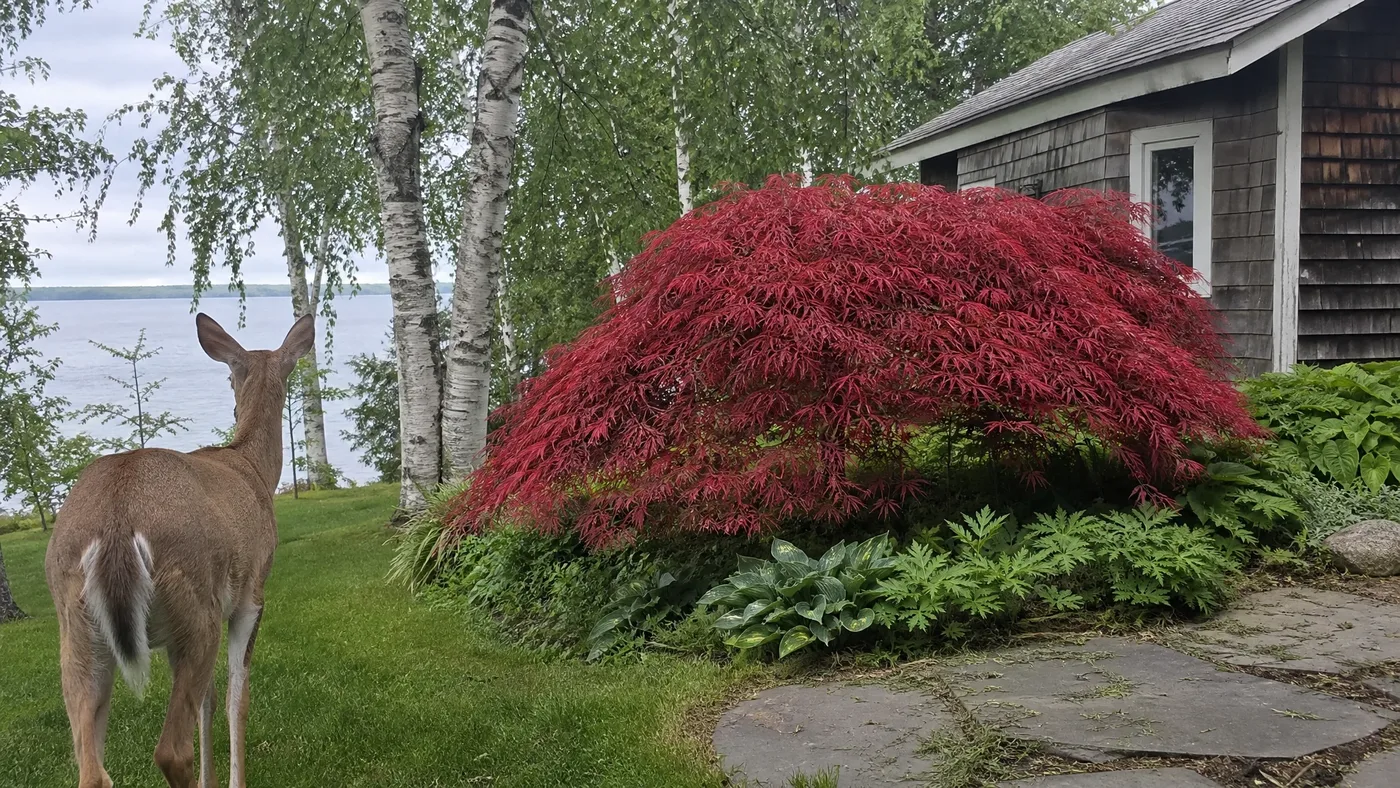
Do Deer Eat Tamukeyama Japanese Maple?
You walk out one morning and find a few twig tips on the lawn and a pale scrape on the trunk that was not there yesterday. Neither looks like much, which is why people shrug it off. The common belief is that deer skip Japanese maples because the foliage is so fine and the tree so ornamental. What we see instead is that deer do eat Tamukeyama when other food runs short, and the species is only mildly resistant to deer damage, which is not the same as deer-proof.
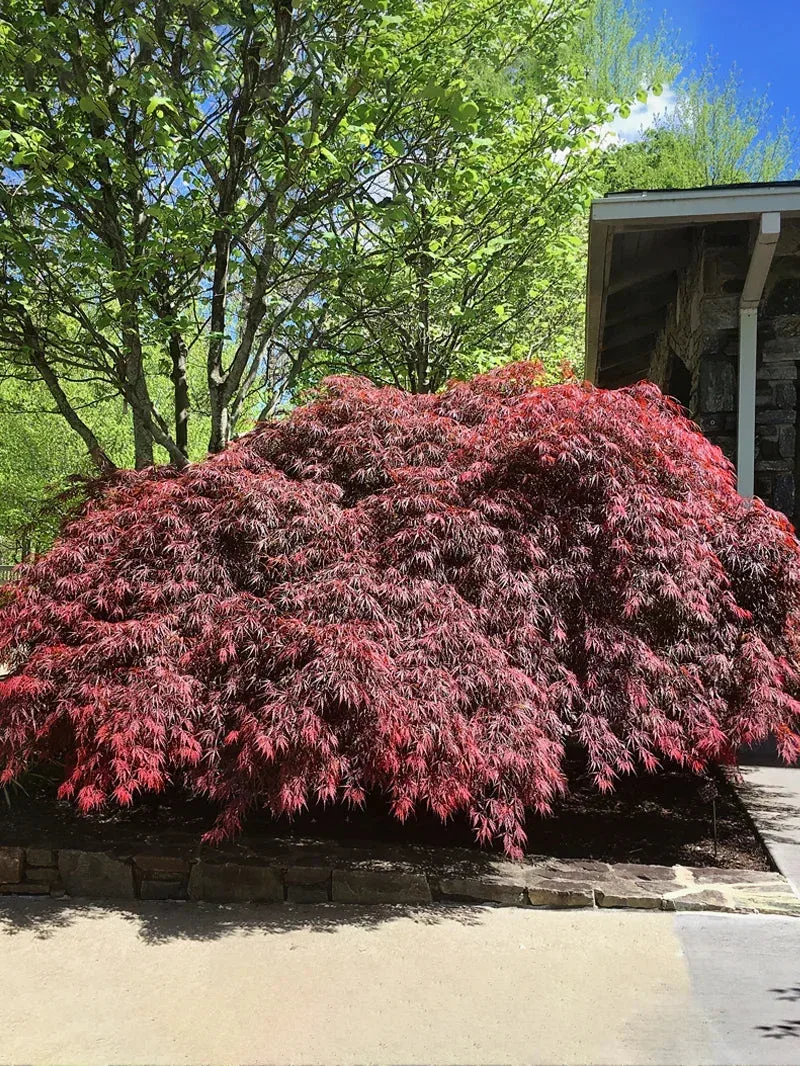
A weeping, grafted tree takes a hit differently from an upright one. Damage can cost you branch tips, a stripped trunk or the whole top. Read on for what each kind of damage looks like, how the shape of this tree puts it in reach, and which fence, guard or repellent answers each sign.
Ragged Leaves and Nibbled Twig Tips
If the leaf edges look torn rather than snipped and the twig tips end in frayed, splintered stubs, deer are the likely cause. Missouri Extension tells you to look for torn leaves or stalks with ragged ends, and that matches what we see on laceleaf maples. Deer grab and pull, so the fine, finger-like leaf lobes of a Tamukeyama end up shredded and scattered under the canopy.
One of the most common questions we get is whether leaves this delicate are too fussy for deer to bother with. They are not, especially in spring when new growth is soft, and again in late summer when pastures dry out.
Your next step depends on how fresh the damage is. If you find one or two nibbled tips, treat it as a warning: apply a repellent today and walk the tree daily for a week. If the damage repeats, stop relying on repellent alone and plan a physical barrier, covered below. Do not prune the stubs right away. Wait until the tree is dormant, then cut back to healthy wood following our guide on when and how to prune a Tamukeyama.
Why Tamukeyama Japanese Maple Hangs Within Reach
A Tamukeyama is a mounded, weeping laceleaf, and the canopy cascades to the ground at roughly 3 to 4 feet tall on a young plant. That means every branch, from the tips at the soil line to the crown, sits in the zone a deer browses without effort. An upright maple loses its lowest branches first. A weeping one has nothing out of reach to hide behind.
Growth is slow, so the tree does not simply outgrow the problem. Clemson puts Japanese maple growth at 10 to 15 feet in 15 years, and our weeping cultivar stays much lower. Mature plants reach about 5 to 8 feet tall and roughly 8 to 13 feet wide, while NC State lists the broader dissectum group at 6 to 12 feet. A standing deer reaches the top of that without trying.
This is why browsing matters more here than on a 20-foot upright tree. A deer can strip the outer shell of a young plant in a few visits, and because the tree grows slowly, you wait years to see the cascade rebuilt. Plan protection from the day you plant, not after the first loss.
Bark Stripped on a Tamukeyama Japanese Maple Trunk
Pale, exposed wood and shredded bark hanging in strips on the trunk points to a buck, not a browsing doe. Nebraska Extension notes that antler rubbing occurs from October through January, with a peak in November. Bucks pick thin, smooth, upright stems, and a young weeping maple trunk fits that description exactly.
The trunk is the weak point of this tree. Most Japanese maple cultivars are grafted, and a Tamukeyama is a thin stem carrying a heavy, spreading canopy. If a rub wraps most of the way around, the bark and the tissue under it cannot carry water upward, and the top can die even though the roots are fine. Where the graft sits, high or low, changes how much stem is exposed, which we cover in our high graft vs low graft guide.
The fix is a guard in place before October. Use a rigid tube or wire cylinder that stands clear of the bark, so the trunk can still thicken, and extend it above antler height. A loose spiral wrap is fine for rabbits but not for a buck. If you buy a young Tamukeyama from us, set the guard the day you plant it. Remove or loosen it in spring and check it each fall.
Clean Angled Cuts Near the Ground
If the stems are snipped off cleanly at a slant, close to the soil, think rabbit. Rabbits have upper and lower front teeth that cut like shears, so the end looks sliced, where deer leave a torn, ragged one. Location helps too. Damage on low stems and on the bark of young trunks near the ground is usually a rabbit, especially after snow covers other food.
On a Tamukeyama the low cascading branches shelter rabbits, which makes the problem harder to spot. Part the skirt of the canopy and look at the lowest stems and the base of the trunk. A cut at an angle on a tip that is only a few inches off the ground confirms it.
The fix differs from the deer fix. A fence built for deer often has gaps that rabbits slip through, so use a cylinder of fine wire mesh around the base of the trunk and around any exposed young stems, with the bottom pushed slightly into the soil. Prune the cut stems back to a bud during dormancy, and watch for new damage as winter weather arrives, which our winter protection guide covers.
Tracks and Droppings Before Any Damage
The best time to protect a Tamukeyama is before it is damaged. Deer leave split, two-toed hoofprints in soft ground and mulch, and small oval droppings in clusters along their route. If you see either within a few yards of the tree, or you see damage on neighboring shrubs, treat that as the deer's first visit, not a passing curiosity.
Walk the edge of your planting once a week in fall and again after snow. Fresh signs near the maple mean you should act within days, not weeks. Set things up in this order:
- Guard the trunk first, since buck rub is the one injury a Tamukeyama may not survive.
- Apply a repellent to the foliage and keep it fresh, especially after rain.
- Check the ground on a regular route for new tracks, droppings or flattened beds.
- Decide on a fence or cage now, while the damage is only a few tracks.
Moving fast here is cheap. Waiting for the first torn branch is not.
Fencing a Cascading Tamukeyama Japanese Maple
A fence is the only protection that stops all deer damage, and a weeping tree changes how you lay it out. A Tamukeyama spreads wider than it is tall, so the fence has to enclose the full canopy, not just the trunk.
Height and Material
A fence works only if deer cannot clear it, and the height that holds varies by region and by how hungry the local herd is. We cannot give you one number, so check with your local extension service for what works in your area. Use sturdy wire or netting that does not sag, and anchor it so a deer cannot push under it.
Spacing Around the Canopy
Keep the fence well outside the drip line. A mature canopy can spread 8 to 13 feet, and branches that hang against the fence let deer nibble through the openings. Leave a clear gap all around so a deer cannot reach in, and allow for the tree to widen over the years. A round or square cage, open at the top only if the fence is tall enough, fits the mound well. If you want the fence to blend into the garden, our landscape ideas guide shows how to place the tree so it does not look like a pen.
Repellents, Cages and Trunk Wraps That Hold Up
Each option protects a different part of the tree and lasts for a different time, so match them to the damage you see. The table compares how long each holds up and what it covers.
| Protection | What it stops | How long it lasts |
|---|---|---|
| Fence | All deer browsing and rubbing | Years, if it stays tight and tall enough |
| Wire cage over a young tree | Browsing on a small plant | Until the tree outgrows it |
| Rigid trunk guard | Buck rub, some rabbit gnawing | Years, but check it each fall |
| Spiral trunk wrap | Rabbit gnawing, light rub | A season or two, then replace |
| Repellent spray | Browsing on leaves and tips | Weeks, and again after rain or new growth |
Repellents have a role, but we do not treat them as a plan. They fade with rain and with each flush of new leaves, and a hungry deer eventually ignores the smell. Rotate products if you rely on them, and use them as a stopgap while you build a barrier.
For most owners the best setup is a rigid guard on the trunk and a cage or fence for the canopy. Skip the thin plastic wraps on a trunk this slender. They trap moisture and do little against a buck.
Match the Damage to Your Tamukeyama Japanese Maple Defense
This is the whole diagnostic in one place. Read the sign on the tree, then apply the matching defense.
- If leaves are torn and tips are ragged, deer are browsing. Use repellent now and build a fence or cage if it repeats.
- If bark is stripped or shredded on the trunk in fall, a buck is rubbing. Fit a rigid guard before October and keep it on through January.
- If stems are cut cleanly at an angle near the ground, rabbits are the cause. Wrap the base in fine wire mesh and prune the stubs in winter.
- If you see tracks or droppings but no damage yet, set the trunk guard first, then plan the fence.
- If the damage goes all the way around the trunk, call us or your local extension service before you prune, since the top may not recover.
Guarding Your Tamukeyama Japanese Maple Through the Seasons
Deer do eat Tamukeyama, and its low weeping form puts every branch in reach, while the thin grafted trunk is the part that cannot easily be replaced. Read the damage before you act. Ragged tips mean deer, a scraped trunk means a buck, and clean angled cuts mean rabbits.
The rule of thumb is simple: protect the trunk first, the foliage second, and check both after each storm.
Tamukeyama Japanese Maple
Nursery-grown Tamukeyama Japanese Maple in sizes from 5 Pot 2-3 ft, shipped to your door.
From $182.10
Shop Now →A Tamukeyama you go to the trouble of protecting from deer should start out well grown. Ours are raised on our farms with softened afternoon sun and soil that stays moist yet drains well, and we grow every top-quality tree and shrub we sell right there. When you are ready for a maple to look after, browse what is in stock now.