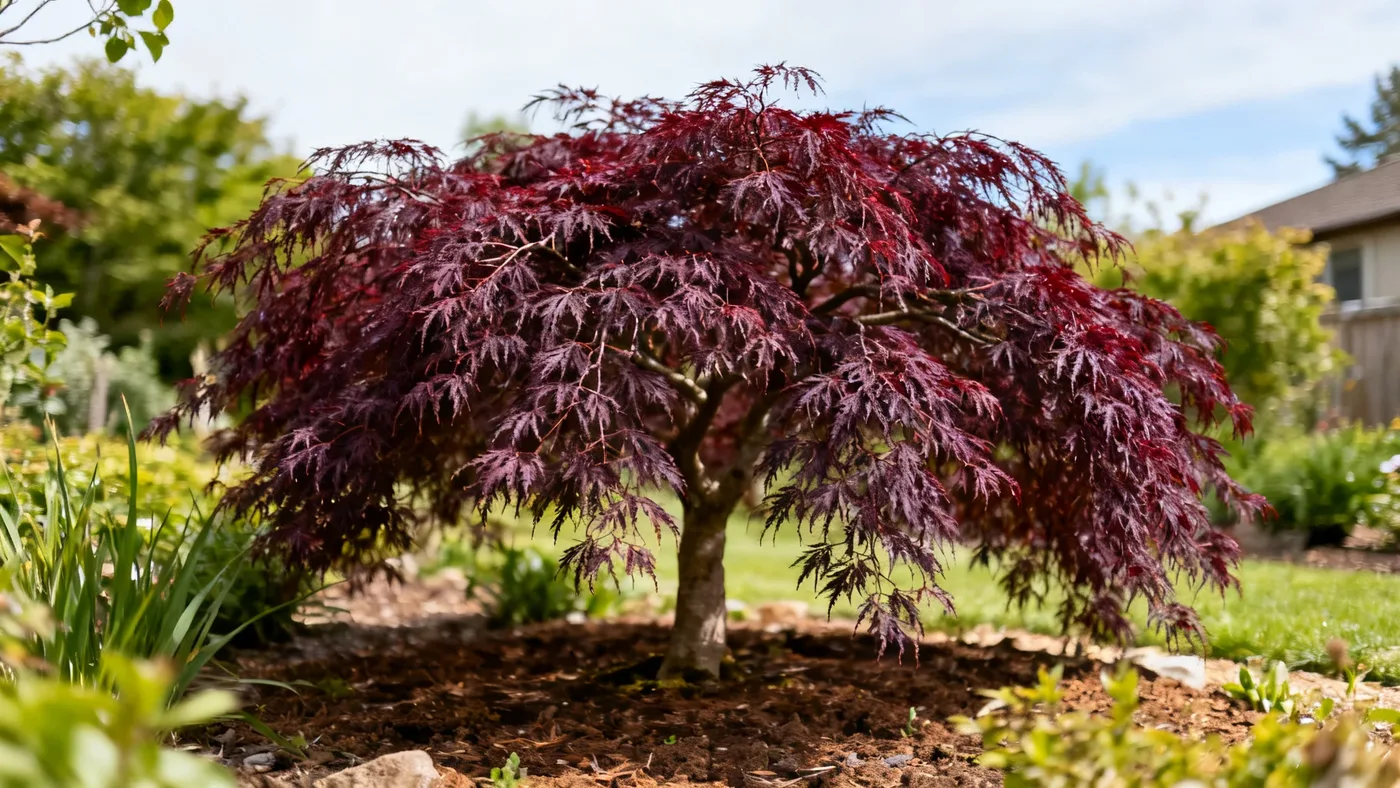
Do You Really Need to Fertilize a Tamukeyama Japanese Maple?
The short answer: maybe. Unlike many ornamental plants, Tamukeyama Japanese Maple grows slowly by design, and a mature tree in decent soil may get by on little to no fertilizer. But the fuller answer depends on your soil, your tree's age, and whether you're growing it in a container or in the ground. Light feeding at the right time can help young plants establish and support older trees stressed by poor soil. The trick is knowing when to feed and what "light" actually means.
Does Your Tamukeyama Japanese Maple Actually Need Fertilizer?
Tamukeyama Japanese Maples are naturally slow growers, putting on roughly 6 to 12 inches of growth per year. That slow pace is part of their appeal, and it also means they don't have the hungry feeding schedule of a fast-growing shade tree. A tree planted in rich, well-drained loam with a soil pH between 5.5 and 6.5 may thrive without any supplemental feeding once established.
You'll want to consider fertilizer if any of these situations apply to you:
- Your soil is sandy, compacted, or depleted (typical in new construction landscapes)
- You're growing your Tamukeyama in a container, which loses nutrients with every watering
- Your tree shows signs of chlorosis (yellowing between leaf veins) or pale, weak spring growth
- You planted your tree in the past two years and want to speed early establishment
- Your tree is recovering from transplant stress or environmental damage
If your soil is already rich and your tree is pushing healthy red-purple foliage each season, hold off on fertilizer. More isn't better with Japanese maples, and excess nitrogen pushes soft, weak growth that's more prone to pests and sunburn damage.
When to Fertilize Your Tamukeyama Japanese Maple
Timing is everything with fertilizing, and for Tamukeyama Japanese Maple, that window is narrow and early: light feeding in early spring before the tree fully leafs out.
In USDA zones 5 through 8 (the hardiness range for this cultivar), early spring means approximately late February through mid-April, depending on where you live. If you're in zone 5 or 6, aim for late March or early April. In zones 7 and 8, early March often works. The goal is to feed the tree as it's beginning to grow but before the weather becomes hot and unpredictable.
Why early spring? Growth is just starting, so nutrients are put to work immediately. Feeding too late in spring or during summer can trigger a flush of tender new growth that heat stress or early frost will damage. Fall feeding (August or later) can delay dormancy and leave the tree vulnerable to winter injury.
Container-grown Tamukeyamas may benefit from a second light feeding in early summer, roughly six weeks after the first application, because containers lose nutrients faster than in-ground soil. For in-ground trees, stick to one annual feeding in early spring.
What Type of Fertilizer to Use
The best fertilizer for Japanese maple is balanced, slow-release, and formulated for acid-loving or woody ornamental plants. This sounds specific because it is. A balanced formula means roughly equal parts nitrogen (N), phosphorus (P), and potassium (K), often labeled as something like 10-10-10 or 5-5-5.
Slow-release matters because it feeds the tree gradually over weeks or months rather than dumping nutrients all at once. Quick-release fertilizers can push the weak, excessive growth you want to avoid.
Look for products labeled "acid-loving plants" or "for woody ornamentals and evergreens." These formulations are designed for plants like Japanese maples, rhododendrons, and azaleas that prefer slightly acidic soil (5.5 to 6.5 pH). They often include micronutrients like iron and magnesium that support the rich foliage color.
Organic options like fish emulsion or composted manure work, but they break down faster and offer less control. Granular synthetic slow-release fertilizers give you the most predictable, steady feeding. Liquid formulations work fine too but require more frequent applications.
Step-by-Step Fertilizing Instructions
Materials You'll Need
- Balanced, slow-release fertilizer (10-10-10 or similar) formulated for acid-loving or woody plants
- Measuring cup or scale (depending on whether your fertilizer is granular or liquid)
- Watering can or hose with a gentle spray nozzle
- Optional: hand gloves to keep fertilizer off your skin
- Container for mixing (if using liquid concentrate)
Instructions
- Check your tree and soil first. Before you fertilize, look at the soil around your tree. If it's bone dry, water it thoroughly a day or two before feeding. Fertilizer works best when the soil is moist but not waterlogged. If you're unsure whether your soil pH is in the right range (5.5 to 6.5), consider a simple soil test. Local extension services often offer these inexpensively.
- Apply in early spring. Choose a day in early spring after the worst frost has passed but before hot weather settles in. In zone 5 or 6, late March through early April is ideal. In zones 7 and 8, early March works well.
- Follow the label rate. Read the product label carefully. The amount varies widely depending on the formulation (a balanced 5-5-5 uses a different amount than a 10-10-10). Apply only the recommended dose. For granular formulas, this is often 1 to 2 tablespoons per small tree, spread in a circle around the base. For established trees, follow your product's guidance for mature specimens.
- Spread around the drip line, not against the trunk. Sprinkle the fertilizer on the soil around the tree, starting about 6 inches from the trunk and extending out to where the branches end (the drip line). Never pile it against the bark, which can scorch the trunk. Mix it lightly into the top inch or two of soil with a hand rake or your fingers.
- Water thoroughly after application. Give the tree a deep watering to dissolve the fertilizer and carry nutrients into the root zone. A slow, steady soak for 20 to 30 seconds (if using a hose) is better than a hard spray.
- Space out additional applications. For container-grown Tamukeyamas, you may repeat this process in early summer (June), about six weeks later. For in-ground trees, one application per spring is usually enough. Never fertilize more than twice per year.
Common Fertilizing Mistakes to Avoid
Mistake 1: Using a high-nitrogen lawn fertilizer. Those bags of 20-10-10 marketed for grass will push tender, weak growth on your Japanese maple and can make it more susceptible to sunburn and pest damage. Stick to balanced formulas designed for ornamental plants.
Mistake 2: Fertilizing in summer or fall. Heat and late-season feeding can trigger growth that doesn't harden off before winter. Stick to early spring only.
Mistake 3: Fertilizing a stressed tree without fixing the real problem. If your Tamukeyama is struggling with yellow leaves, the issue might be poor drainage, alkaline soil, or heat scorch, not nitrogen starvation. Fertilizer won't fix those. Check soil moisture, drainage, and sun exposure before you feed.
Mistake 4: Over-fertilizing container plants. Containers lose nutrients quickly, but that doesn't mean doubling the dose. A light second application in summer is all most container trees need.
Signs Your Tamukeyama Japanese Maple Needs Feeding
Not every symptom calls for fertilizer. But a few signs suggest your tree would benefit from light feeding in spring:
- Pale, weak spring growth that's noticeably shorter than past years
- Yellowing between the leaf veins (chlorosis), often a sign of iron deficiency in alkaline or compacted soil
- Leaves that are smaller than normal or less deeply colored
- A newly planted tree (in its first two seasons) that's slow to establish
If you see these signs, light feeding in early spring can help. But if the issue persists after feeding, dig into your soil pH, drainage, and watering routine. A proper growing environment matters far more than fertilizer.
For a full picture of Tamukeyama care, including soil preparation, watering, and problem-solving, read our complete growing guide for Tamukeyama Japanese Maple.
Quick Reference Checklist
| Aspect | Guidelines |
|---|---|
| Fertilizer type | Balanced (10-10-10 or 5-5-5), slow-release, formulated for acid-loving or woody ornamental plants |
| When to fertilize | Early spring only (late Feb to mid-Apr, depending on USDA zone) |
| Frequency | Once per year for in-ground trees; up to twice (spring + early summer) for containers |
| Soil pH target | 5.5 to 6.5 (slightly acidic to neutral) |
| Application rate | Follow product label; typically 1-2 tablespoons for granular, per manufacturer guidance for liquid |
| Placement | 6 inches from trunk, out to the drip line; never against bark |
| After application | Water thoroughly to move nutrients into the root zone |
| Skip fertilizer if | Tree is growing well, foliage is rich-colored, soil is rich and well-drained |